How to Write an Invoice UK: Example and Free Template
Make a clear bill your customer can approve and pay. Follow one fictional £340 job from the agreed price to the finished invoice, then the same steps for a VAT-registered business, with the rules checked against GOV.UK and HMRC.
The first invoice is the hard one
Take Ellie, who has just gone freelance as a designer in Amble, on the Northumberland coast. Her first client, a holiday cottage company in Alnwick, has signed off a brochure. The work is done, the client is happy, and their office manager sends a friendly line: "Great, just pop an invoice over and I'll get it paid." Ellie realises she has never written one. Does it need a number? Should she add VAT? What if she gets something wrong and the client's accounts team sends it back?
Writing an invoice is not difficult, but it is one of those jobs where small omissions cost real time. An invoice without a purchase-order number sits in a queue. One with the wrong bank details is paid to nobody. One that charges VAT you are not registered for is a problem you have to unwind. This guide follows Ellie's first invoice line by line, then does the same for a VAT-registered electrician, so you can see exactly what goes where.
Quick answer
To write an invoice in the UK, show a unique invoice number, your name or company name and address, the customer's name and address, a clear description of what you supplied, the supply date, the invoice date, the amount for each item, any VAT and the total owed. Add your payment terms and bank details so the customer can pay without asking. If you are VAT registered and your customer is too, it must be a VAT invoice, which also shows your VAT number and the VAT separately.
- GOV.UK lists nine things every invoice must include; sole traders and limited companies each add their own name rules.
- Unless you agree a date, a business customer must pay within 30 days of receiving the invoice or the work.
- Do not charge VAT unless you are VAT registered, and never record the customer's payment as a second sale.
- Correct a sent invoice with a credit note, not by editing it, and keep copies for at least five or six years.
What is an invoice?
An invoice is a request for payment: a dated record of what you supplied, to whom, and how much they owe. It is not the same as a receipt. GOV.UK puts it plainly: a receipt is an acknowledgement of payment, while an invoice asks for one (GOV.UK, invoicing and taking payment). In your books, the invoice is the moment a sale is recorded and the customer starts to owe you money. The payment, when it arrives, settles that debt; it is not a second sale.
You are legally required to issue an invoice when both you and your customer are VAT registered. Outside that, an invoice is still how almost every business customer expects to be billed, and it is the evidence behind the income on your tax return.
How to write an invoice
Start with who is billing whom, describe the work clearly, then check the dates and total. The invoice should let your customer approve and pay it without asking what the charge relates to. You can use our free UK invoice template as you follow the example; it creates a PDF or Word document without an account.
If you are wondering how to make an invoice from nothing, these are the steps in the order a careful bookkeeper does them:
- Put the word "Invoice" at the top. It sounds obvious, but a document headed "Bill" or "Statement" can be routed to the wrong place in a larger customer's accounts team.
- Add your details. Your name or business name, address and contact details. Sole traders and limited companies have different rules, set out below.
- Add the customer's details. Their business name and billing address, and the name of the person or team who approves invoices if you know it.
- Give it a unique invoice number. Never reuse one. A simple sequence such as AD-2026-018 works.
- Add the dates. The supply date (when you did the work or delivered the goods) and the invoice date (when you issue it). They can be the same day.
- Describe each item. What you supplied, the quantity or hours, the price for each, and the line total.
- Add VAT only if you are VAT registered, at the right rate, shown separately.
- Show the total owed.
- Add payment terms and how to pay. The due date, your bank details, and the reference to quote.
- Add the customer's purchase-order number if they gave you one.
- Check, save a copy, and send it.
A simple invoice example
Amble Design is a fictional sole trader who is not VAT registered. She completed a brochure on 8 October and invoices on 10 October. The agreed fee is six hours at £50 plus £40 for printing. Her customer agreed payment within 14 days.
| Field | Illustrative invoice |
|---|---|
| Invoice number | AD-2026-018 |
| Supplier | Amble Design, with the proprietor’s name, address and contact details |
| Customer | The customer’s business name and billing address |
| Supply date | 8 October 2026 |
| Invoice date | 10 October 2026 |
| Design | 6 hours × £50 = £300 |
| Printing | £40 |
| VAT | Not charged: supplier is not VAT registered |
| Total due | £340 |
| Agreed due date | 24 October 2026 |
| Payment reference | AD-2026-018 |
The number identifies this invoice and is not reused for another sale. The description explains the work; “services” alone would make it harder to approve. Payment details and a useful contact complete the handover.
Laid out as a document, Ellie's invoice reads top to bottom like this. Copy the shape, not the details:
INVOICE No. AD-2026-018
From: Ellie Marsh, trading as Amble Design, 4 Harbour Row, Amble, Northumberland. [email protected], 07700 900123
To: Coquet Cottages Ltd, accounts team, 12 Bondgate Within, Alnwick
Date of supply: 8 October 2026 Invoice date: 10 October 2026
Brochure design, 12 pages, two rounds of amends: 6 hours at £50 = £300.00
Printing, 250 copies (pass-through cost as agreed): £40.00
Total due: £340.00 Not VAT registered, no VAT charged.
Payment due by 24 October 2026 (14 days, as agreed). Bank transfer to E Marsh, sort code 00-00-00, account 00000000. Please quote AD-2026-018.
Everything in that example is fictional, including the bank details. Notice what it does not say: no VAT line pretending to be zero, no vague "services rendered", and no due date that was never agreed.
What must a UK invoice include?
The GOV.UK invoice checklist requires an identifying number, supplier and customer details, a description, supply and invoice dates, charges, applicable VAT and the amount owed. A sole trader includes their own name and trading name, plus a service address where required. A limited company uses its full registered name. VAT invoices have additional requirements.
Payment instructions, an agreed due date and a purchase-order reference where requested help the customer act on it. Check these against the contract rather than inventing terms after the work is finished.
| Detail | Every invoice | Sole trader adds | Limited company adds |
|---|---|---|---|
| Unique identification number | Required | ||
| Your name, address and contact information | Required | Your own name and any business name you trade under | The full company name exactly as on the certificate of incorporation |
| Address for legal documents | Required if you use a business name | ||
| Customer's name and address | Required | ||
| Clear description of what you are charging for | Required | ||
| Supply date and invoice date | Required | ||
| Amounts charged, VAT if applicable, total owed | Required | ||
| Directors' names | Optional, but if you show any you must show all of them |
Source: GOV.UK, Invoices: what they must include, checked 11 October 2026.
How to write a VAT invoice
Once you are VAT registered, an invoice to another VAT-registered business must be a VAT invoice, and HMRC's VAT guide sets out what it must show (VAT Notice 700, section 16). On top of the ordinary details you need:
- a sequential number, based on one or more series, that uniquely identifies the invoice;
- the time of supply (the tax point), and the date of issue if different;
- your name, address and VAT registration number;
- for each line, the quantity or extent of the service, the VAT rate, and the amount excluding VAT;
- the total excluding VAT, any cash discount rate offered, and the total VAT, which must be in sterling;
- the unit price for countable goods or services.
Here is a worked example. Wharfedale Electrical Ltd, a fictional VAT-registered company, rewires the kitchen of a café in Otley. The job finishes on 2 October and the invoice goes out on 5 October.
| Line | Qty | Unit price | VAT rate | Net | VAT |
|---|---|---|---|---|---|
| Labour, kitchen rewire | 12 hrs | £45.00 | 20% | £540.00 | £108.00 |
| Cable, consumer unit and fittings | 1 | £260.00 | 20% | £260.00 | £52.00 |
| Total | £800.00 | £160.00 | |||
| Amount due | £960.00 |
Because the invoice was issued within 14 days of the job finishing, its date, 5 October, becomes the tax point under HMRC's 14-day rule, so the £160 belongs on the VAT return covering 5 October. Had Wharfedale waited three weeks, the tax point would have stayed at 2 October. If the café had paid a deposit before the work, that payment would have created its own earlier tax point for the amount paid. Normally you must issue a VAT invoice within 30 days of the tax point.
Simplified VAT invoices. For a supply of £250 or less, and if your customer agrees, you can issue a simplified VAT invoice showing your name, address and VAT number, the tax point, a description, and for each VAT rate the total including VAT and the rate. Above £250, or whenever the customer asks for one, issue a full VAT invoice.
Two traps catch new registrants. First, you cannot charge VAT before you are registered; if you are waiting for your number, HMRC's rules let you issue the VAT invoices within 30 days of being told it. Second, zero-rated and exempt items on the same invoice must clearly show no VAT is payable, with a separate total for their value. Our guide to the VAT threshold in 2026 covers when registration becomes compulsory.
Invoice numbers: how to number your invoices
The only legal requirement for a non-VAT invoice is that the number is unique. For a VAT invoice it must also be sequential within a series. In practice, a sequential series is what you want anyway: a gap or a duplicate is the first thing an accountant, a customer's accounts team or an HMRC officer will ask about.
- Simple: 0001, 0002, 0003.
- With a prefix and year: AD-2026-018. Easy to search in emails and on bank statements.
- One series per business, not per customer. Per-customer numbering makes gaps hard to prove are innocent.
Never reuse a number for a corrected invoice. If an invoice was wrong, cancel it with a credit note and issue a new one with the next number.
Payment terms, due dates and late payment
You can set your own terms, including payment up front or a discount for paying early. If you do not agree a payment date, GOV.UK says the customer must pay within 30 days of getting your invoice or the goods or service (GOV.UK, payment obligations). For business-to-business deals, an agreed payment date must usually be within 60 days, or 30 days for public authorities; a longer period must be fair to both sides.
Write the due date as a date, not a phrase. "Payment due by 24 October 2026" is harder to misread than "14 days net", and it is the date your chasing starts from.
What you can charge when a business pays late
If another business pays late, the late payment legislation lets you claim statutory interest of 8% plus the Bank of England base rate, unless your contract sets a different rate (GOV.UK, interest on late commercial payments). You can also claim a fixed sum towards recovery costs, once per invoice:
| Amount of the debt | Fixed sum you can claim |
|---|---|
| Up to £999.99 | £40 |
| £1,000 to £9,999.99 | £70 |
| £10,000 or more | £100 |
GOV.UK's own worked example: on a £1,000 debt with a base rate of 0.5%, annual statutory interest is £85, about 23p a day. To claim it, send a new invoice for the interest. Whether to charge it is your call; many small suppliers mention it on the invoice and use it only when a customer becomes a habit. These rights apply between businesses, not to consumers.
How to make an invoice in the free template
- Enter the supplier and customer details.
- Add a distinct invoice number and the two dates.
- Add each item, quantity and price; check the arithmetic.
- Only apply VAT when you are registered and using the appropriate VAT treatment.
- Enter the agreed payment terms and a clear reference.
- Preview the document, download it and check the saved version before sending.
For Amble’s example, the check is £300 + £40 = £340. The invoice records a sale; payment records the settlement. Keep the invoice even if the customer pays immediately.
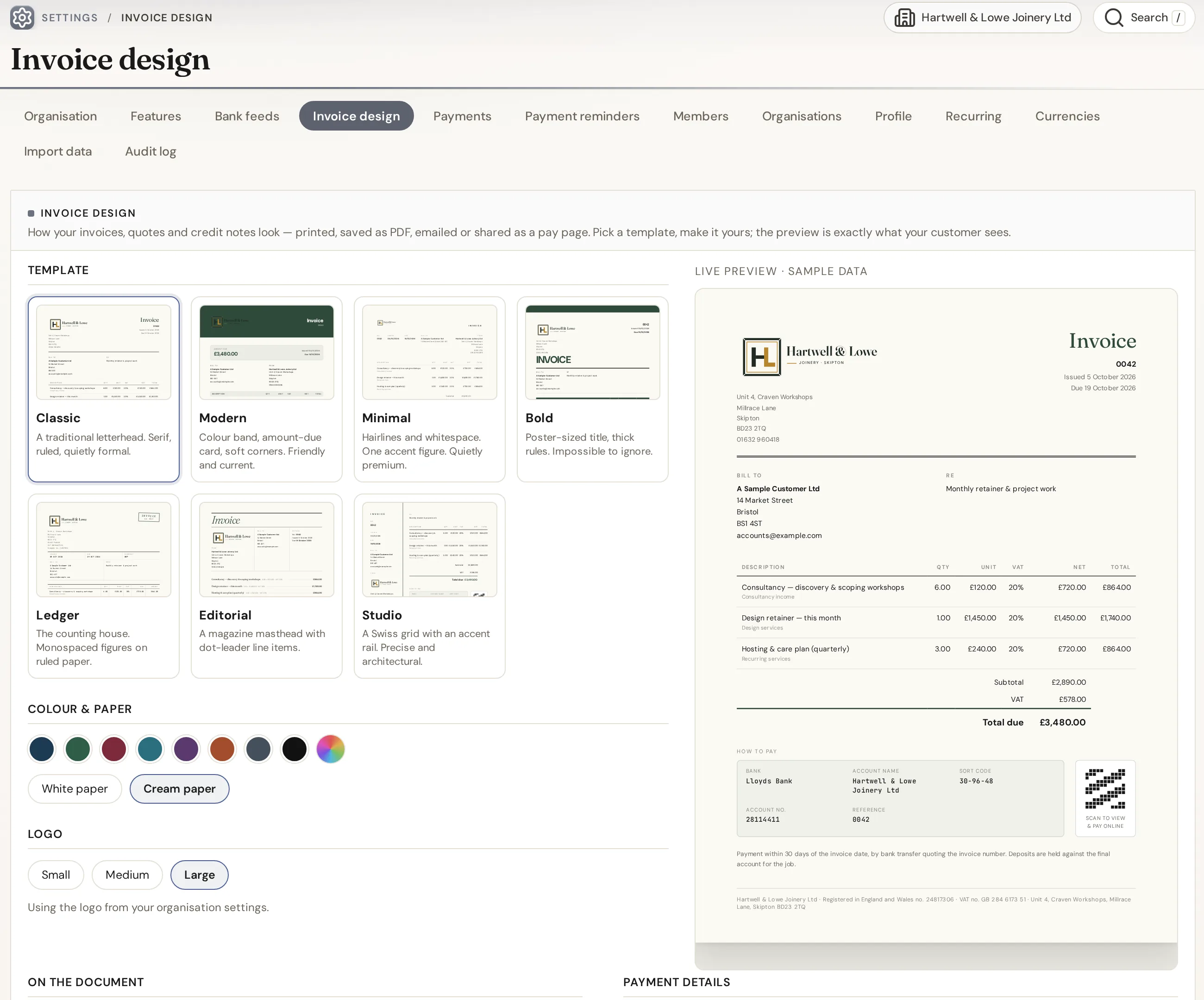
The invoice template runs in your browser and nothing you type leaves it. It uses the same document designs as IQ Books, so if you later move into the full app your invoices look the same.
How to make an invoice in Word, Excel or on your phone
You do not need special software to write a valid invoice. A Word document or an Excel sheet works if it shows the required details. The risks are practical rather than legal:
- Numbering drifts. Copying last month's file and forgetting to change the number is the most common way duplicates appear.
- Formulas break. In Excel, a line added below the SUM range leaves the total short. Check the total by hand on the first few.
- Nothing tracks payment. A folder of PDFs does not tell you who owes what. You need a list, at minimum, of number, customer, amount, due date and date paid.
- Send a PDF, not the editable file. It looks the same on every device and cannot be altered by accident.
On a phone, the simplest route is a browser-based tool rather than another app to install. Our free template works in a phone browser, and IQ Books itself runs in the browser on a phone as well as a laptop.
Can an invoice be handwritten?
Yes. Nothing in the rules requires an invoice to be typed. A handwritten invoice from a duplicate book is valid if it carries the same details: number, both parties, dates, description, amounts and, if registered, the VAT details. Keep the carbon copy as your record, and make sure the number sequence in the book matches the one in your records.
Sending an invoice and recording payment
In the standalone template, download the document and send it through your usual channel. Check the destination and attachment before sending. Store your copy and record whether it is unpaid, part paid or settled.
In IQ Books, the invoice is part of the customer account and ledger. The free plan lets you create invoices, print or download them and share a payment-page link. Emailing invoices and automatic reminders from the app are paid features. When payment arrives, match it against the invoice rather than entering a second sale.
How to write an invoice email
Keep the email short and make the attachment do the work. A subject line the customer can search for, the amount and due date in the body, and nothing that needs a reply:
Subject: Invoice AD-2026-018 from Amble Design, £340 due 24 October
Hi Sam,
Please find attached invoice AD-2026-018 for the brochure design and printing, £340.00, due by 24 October 2026. Bank details are on the invoice; please quote the invoice number as the reference.
Thanks again for the project. Any questions about the invoice, just reply to this email.
Ellie
If the customer gave you a purchase-order number, put it in the subject line as well. Larger companies often match invoices to orders automatically and park anything without one.
When the money arrives
The payment closes the invoice; it does not create new income. Record it against the invoice so the customer's balance goes to nil. If they pay part, record the part and leave the rest outstanding. If they pay several invoices in one transfer, split the receipt across them. Our guide to matching invoices to payments covers the awkward cases, and double-entry bookkeeping shows why a payment recorded as a sale doubles your income.
Invoice, quote or pro forma?
Use a quote to set out a proposed price before the customer commits. An invoice records the bill. A pro forma invoice serves a different purpose and is not a VAT invoice. Choose the right document for the transaction rather than changing the heading on a finished invoice.
| Document | When you send it | Creates a debt? | Goes in your books? |
|---|---|---|---|
| Quote | Before the customer agrees | No | No |
| Pro forma invoice | Before supplying, to ask for payment up front | No | No; record the money only if it is paid |
| Invoice | When you have supplied, or as agreed | Yes | Yes: a sale and money owed |
| Credit note | To reduce or cancel an invoice | Reduces one | Yes, reversing all or part of the invoice |
| Receipt | After you have been paid | No | Evidence of the payment only |
Fixing a mistake: credit notes, not edits
Once an invoice has been sent, do not change it and send it again under the same number. Your customer may already have entered it, and two versions of one document is exactly what an inspection looks for. Instead, issue a credit note referring to the original invoice for the amount that was wrong, or for the whole amount, then issue a fresh invoice with a new number if needed. For VAT invoices, HMRC's guide expects you to give the customer a credit note and keep a copy.
A draft that has not been sent is different: correct it freely. Accounting software that separates drafts from issued invoices makes this line clear.
How long to keep invoices
Your sales invoices are part of your business records. If you are self-employed, keep records for at least five years after the 31 January submission deadline of the tax year they relate to (GOV.UK). A limited company keeps them for six years from the end of the last financial year they relate to, longer in some cases (GOV.UK). Digital copies are fine, as long as they are complete and readable.
Common invoice mistakes to catch before sending
- Reusing an invoice number.
- Sending to the wrong customer or missing a requested purchase-order reference.
- Confusing the date of work with the invoice date.
- Charging VAT when not registered, or assuming every item has the same treatment.
- Showing payment instructions that differ from the agreed supplier details.
- Recording the customer’s later payment as another sale.
Two more that cause slow payment rather than errors: sending the invoice to the person who ordered the work instead of the accounts address, and putting a due date on the invoice that is shorter than the terms the customer agreed. If your bank details ever change, tell customers by phone as well as email; invoice fraud often starts with a convincing "our bank has changed" message.
Invoice requirements checked against the GOV.UK guide on 11 October 2026. For VAT-specific documents, check HMRC’s VAT invoice requirements.
Make an invoice free
Use the free template for a one-off, or keep every invoice, payment and VAT return in one ledger with IQ Books, free for one organisation.
Make an invoice freeFrequently Asked Questions
Enter your supplier and customer details, a unique number, the supply and invoice dates, itemised charges and the total. Check applicable VAT and the agreed payment terms, then preview and save the document.
Head it "Invoice", then show a unique number, your name and address, the customer's name and address, the supply date and invoice date, a clear description of each item with its price, any VAT, and the total owed. Add the due date and your bank details with a reference to quote. That is everything GOV.UK requires for a non-VAT invoice.
Yes. The free invoice template makes a PDF or Word document in your browser. You still need to retain the record and track its payment.
Yes. Sole traders invoice in their own name, adding any business name they trade under. If you use a business name you must also show an address where legal documents can be delivered to you. You do not need a limited company or a VAT number to invoice.
No. Do not charge VAT if you are not registered. Registered businesses must check the appropriate VAT treatment and invoice requirements.
A VAT invoice is an invoice with extra details HMRC requires: your VAT registration number, the tax point, the VAT rate and net amount for each line, and the total VAT in sterling. You must issue one when you and your customer are both VAT registered, and your customer needs it to reclaim the VAT.
GOV.UK says that unless you agree a payment date, the customer must pay within 30 days of receiving your invoice or the goods or service. Between businesses, payment counts as late after that point, and you can claim statutory interest and a fixed recovery sum.
Between businesses, yes: statutory interest is 8% plus the Bank of England base rate unless your contract sets another rate, plus a fixed sum of £40, £70 or £100 depending on the size of the debt. Send a new invoice for the interest. These rights do not apply to consumers.
Yes. A handwritten invoice is valid if it shows the same required details as a typed one, including a unique number. Keep a copy, such as the carbon from a duplicate book, as your record.
Issue a credit note that refers to the original invoice for the amount that was wrong, or the whole amount, and send a new invoice with a new number if needed. Do not edit and resend the original under the same number.
Self-employed people keep records for at least five years after the 31 January filing deadline for the tax year. Limited companies keep them for six years from the end of the financial year they relate to, longer in some cases.
You can create, download and share an invoice payment-page link on the free plan. Emailing invoices and automatic reminders from the app are paid features.