Double-Entry Bookkeeping: Debits, Credits and Examples
Follow the same £300 sale from invoice to payment. The bank changes twice; the sale is recorded once. Then the rules for debits and credits, a dozen worked entries, a trial balance, and the mistakes that balance perfectly.
Why your accounts need two sides
Picture Sam, who runs a bike repair workshop in Kendal and has kept her books in a spreadsheet for two years: money in on the left, money out on the right. It worked until the bank asked for a balance sheet to support a loan application. "What do you own, what do you owe, and how much of it is yours?" Her spreadsheet could tell them how much cash moved. It could not tell them that £1,800 of repairs were invoiced but unpaid, that she still owed a parts supplier £600, or that the van was bought partly with a loan.
That is the problem double-entry bookkeeping solves. Every transaction is recorded as a movement between two accounts, so the books show not just cash, but what the business owns and owes at any moment. It sounds abstract. Once you see four entries side by side, it is not.
Quick answer
Double-entry bookkeeping records every transaction in at least two accounts, so total debits always equal total credits. A debit increases an asset or an expense and reduces a liability, income or capital; a credit does the opposite. Invoicing a customer £300, for example, debits trade debtors and credits sales; when they pay, you debit the bank and credit trade debtors, so the sale is counted once and the cash once.
- Assets, expenses and drawings increase with a debit; liabilities, income and capital increase with a credit.
- Your bank statement is written from the bank's side, so money in shows as a credit there and a debit in your books.
- Assets always equal liabilities plus capital; every correct entry keeps that equation true.
- A balanced trial balance proves the arithmetic, not the accounts: omissions and wrong accounts still balance.
What is double-entry bookkeeping?
Double-entry bookkeeping records both sides of a transaction. The total debit entries equal the total credit entries. A debit is not automatically bad and a credit is not automatically income: the meaning depends on the account. Assets and expenses normally increase with debits; liabilities, equity and income normally increase with credits.
The idea is that nothing appears from nowhere. If the bank balance goes up, something else explains it: a sale, a loan, the owner putting money in. If the business buys a van, cash goes down and a new asset appears. Recording both halves is what lets the books produce a profit and loss account and a balance sheet from the same entries, and it is why an error in one place usually shows up somewhere else.
The accounting equation
Double entry rests on one line:
Assets = Liabilities + Capital
Everything the business owns (assets) was paid for either by someone it owes (liabilities) or by the owner (capital, which includes profit kept in the business). Every correct entry keeps the two sides equal. When Sam borrows £5,000, the bank balance (an asset) rises by £5,000 and the loan (a liability) rises by £5,000. When she makes a profit, assets rise and so does capital, because profit belongs to the owner.
Income and expenses are really temporary parts of capital. They are kept separately during the year so you can see profit, then closed into capital at the year end.
Debits and credits: the rules
Debit (Dr) means the left side of an account and credit (Cr) the right. Which one increases a balance depends on the type of account:
| Account type | Examples | Increases with | Decreases with | Normal balance |
|---|---|---|---|---|
| Assets | Bank, trade debtors, van, stock | Debit | Credit | Debit |
| Expenses | Rent, stationery, wages, parts | Debit | Credit | Debit |
| Drawings | Money the owner takes out | Debit | Credit | Debit |
| Liabilities | Trade creditors, loans, VAT owed | Credit | Debit | Credit |
| Income | Sales, interest received | Credit | Debit | Credit |
| Capital | Owner's investment, retained profit | Credit | Debit | Credit |
UK bookkeeping students learn this as DEADCLIC: Debits for Expenses, Assets and Drawings; Credits for Liabilities, Income and Capital. If you remember nothing else, remember that. Every entry has at least one debit and one credit, and the totals match.
Is a debit money in or money out?
In your books, money into the bank is a debit to the bank account, because the bank balance is an asset and assets increase with debits. This is the single most confusing thing for beginners, and the reason is your bank statement. The statement is the bank's record of you, and to the bank your money is a liability: it owes it to you. So when you pay money in, the bank credits your account. Your books show the same event from your side, as a debit. Neither is wrong; they are mirror images.
The traditional "golden rules"
Older textbooks, and many courses outside the UK, teach the same logic as three golden rules based on the kind of account:
- Real accounts (things you own): debit what comes in, credit what goes out.
- Personal accounts (people and businesses): debit the receiver, credit the giver.
- Nominal accounts (income and expenses): debit expenses and losses, credit income and gains.
They produce exactly the same entries as DEADCLIC. Use whichever sticks.
Four worked examples
Take a fictional sole trader who is not VAT registered. We leave tax and opening balances out so each movement is visible.
| Event | Debit | Credit | What changed |
|---|---|---|---|
| Owner introduces £1,000 | Bank £1,000 | Capital £1,000 | Cash increases; the owner’s investment increases |
| Buy stationery for £40 | Stationery expense £40 | Bank £40 | Profit and cash both decrease |
| Invoice a customer £300 | Trade debtors £300 | Sales £300 | Profit increases; no cash has arrived yet |
| Customer pays £300 | Bank £300 | Trade debtors £300 | The debt is settled; no second sale is recorded |
Across these entries, debits and credits each total £1,640. Closing bank is £1,260, debtors are nil and profit is £260. The balance sheet balances: assets of £1,260 equal the £1,000 owner investment plus £260 profit.
The same four entries as T-accounts
Bookkeepers sketch each account as a T: debits on the left, credits on the right. The bank account after the four entries looks like this:
| Bank: debit (in) | £ | Bank: credit (out) | £ |
|---|---|---|---|
| Capital introduced | 1,000 | Stationery | 40 |
| Customer payment | 300 | Balance carried down | 1,260 |
| Total | 1,300 | Total | 1,300 |
The trade debtors account has £300 on the debit side from the invoice and £300 on the credit side from the payment, so it closes at nil. Sales has £300 on the credit side and nothing else.
More double-entry bookkeeping examples
Back to Sam's workshop, still not VAT registered. These are the entries that her single-column spreadsheet could not show:
| Event | Debit | Credit | Why |
|---|---|---|---|
| Takes a £5,000 bank loan | Bank £5,000 | Bank loan £5,000 | Cash in, but it is owed back: a liability, not income |
| Buys a van for £4,000 | Van (fixed asset) £4,000 | Bank £4,000 | One asset swapped for another; no expense yet |
| Parts supplier's bill, £600 on 30 days | Parts and materials £600 | Trade creditors £600 | The cost is recognised when billed, not when paid |
| Pays the parts bill | Trade creditors £600 | Bank £600 | Clears the debt; the cost was already counted |
| Loan repayment of £250, including £30 interest | Bank loan £220 and Loan interest £30 | Bank £250 | Only the interest is an expense; the rest reduces the loan |
| Repair paid on the spot, £120 | Bank £120 | Sales £120 | No invoice outstanding, so no debtor in between |
| Sam takes £500 for herself | Drawings £500 | Bank £500 | Not a business expense; it reduces her capital |
The loan repayment is the one most often got wrong. Posting the whole £250 as an expense understates profit by £220 a month and leaves the loan on the balance sheet at its original value forever. Ask the lender for a statement that splits capital and interest.
Double entry with VAT
Once a business is VAT registered, most sales and purchases touch a third account: VAT. The entries still balance; there are just three lines instead of two. Say a VAT-registered business invoices £300 plus VAT at 20%, then buys a £120 tool plus VAT on a card:
| Event | Debit | Credit |
|---|---|---|
| Invoice £300 + £60 VAT | Trade debtors £360 | Sales £300; VAT £60 |
| Customer pays | Bank £360 | Trade debtors £360 |
| Buy a tool, £120 + £24 VAT | Tools and equipment £120; VAT £24 | Bank £144 |
The VAT account now has a £60 credit and a £24 debit: a £36 credit balance, which is what the business owes HMRC for the period. Sales show £300, not £360, because the VAT was never the business's income. This is why a VAT return can be checked against the ledger, and why our VAT reconciliation guide starts from that control account.
Why an invoice and a payment are separate
The £300 invoice creates a customer balance and a sale. Its payment replaces that customer balance with cash. Recording another sale when the payment arrives would double the revenue. This is why matching bank receipts to the existing invoice matters. See the invoice example and invoice-to-payment matching.
The same applies to bills. A supplier bill is a cost and a debt on the day it arrives; the payment clears the debt. Code the payment as "rent" or "parts" as well and the cost appears twice.
From the journal to the trial balance
Traditional bookkeeping has three layers, and software still follows them even if you never see them:
- Books of prime entry: the sales day book, purchases day book, cash book and the journal, where each transaction is first recorded.
- The nominal (general) ledger: one account per category, where the debits and credits are posted.
- The trial balance: a list of every ledger account's balance, debits in one column and credits in the other.
Here is the trial balance after the four worked examples:
| Account | Debit £ | Credit £ |
|---|---|---|
| Bank | 1,260 | |
| Trade debtors | 0 | |
| Stationery | 40 | |
| Capital | 1,000 | |
| Sales | 300 | |
| Total | 1,300 | 1,300 |
The income and expense lines become the profit and loss account (£300 sales less £40 stationery is £260 profit). The rest become the balance sheet. A trial balance that does not balance tells you an entry is one-sided or mistyped. One that does balance tells you much less than people think.
A balanced trial balance can still be wrong
Equal debits and credits test arithmetic, not the truth of the accounts. A sale posted twice can balance. A cost assigned to the wrong account can balance. A completely omitted bill leaves the trial balance balanced too. Reconcile the bank, check customer and supplier records, and inspect unusual movements.
Bookkeeping courses name six kinds of error that a trial balance cannot catch:
| Error | What happened | Example |
|---|---|---|
| Omission | The transaction was never entered | A supplier bill left in a drawer |
| Commission | Right type of account, wrong one | A payment from Customer A posted to Customer B |
| Principle | Wrong type of account | The new van posted to repairs, an expense |
| Original entry | Wrong amount on both sides | £540 entered as £450 throughout |
| Reversal | Debit and credit swapped | A customer refund recorded as a receipt |
| Compensating | Two errors cancel out | Sales £100 too high and an expense £100 too high |
Every one of these balances. The checks that catch them are outside the trial balance: a bank reconciliation, agreeing customer and supplier balances to statements, and looking at the accounts for anything that does not make sense.
Single-entry or double-entry?
Single-entry bookkeeping is a list of money in and money out, much like Sam's spreadsheet. For a small sole trader on the cash basis, with no stock, no borrowing and no customers on credit, it can be enough to complete a tax return. It breaks down as soon as the business needs to know what it is owed, what it owes, or what it owns, and it gives you no built-in check that anything is missing.
Limited companies prepare a balance sheet every year, which in practice needs double-entry records. So does anyone applying for finance, carrying stock, or invoicing on credit. The good news is that you rarely type a debit or credit by hand any more: accounting software makes both entries when you raise an invoice, record a bill or code a bank line.
Double-entry in IQ Books and CodeIQ
IQ Books is the ledger of record: its transactions create the accounting entries. CodeIQ helps code bank transactions through its eight-phase pipeline, including invoice matching and VAT classification, before review and posting. It complements Xero, QuickBooks, Sage and Pandle as well as IQ Books.
The practical task is to choose the right transaction and supporting document. Do not create a manual journal to record an invoice already in the sales ledger, and do not book a transfer between your own bank accounts as turnover. Review the suggested account and VAT treatment before posting.
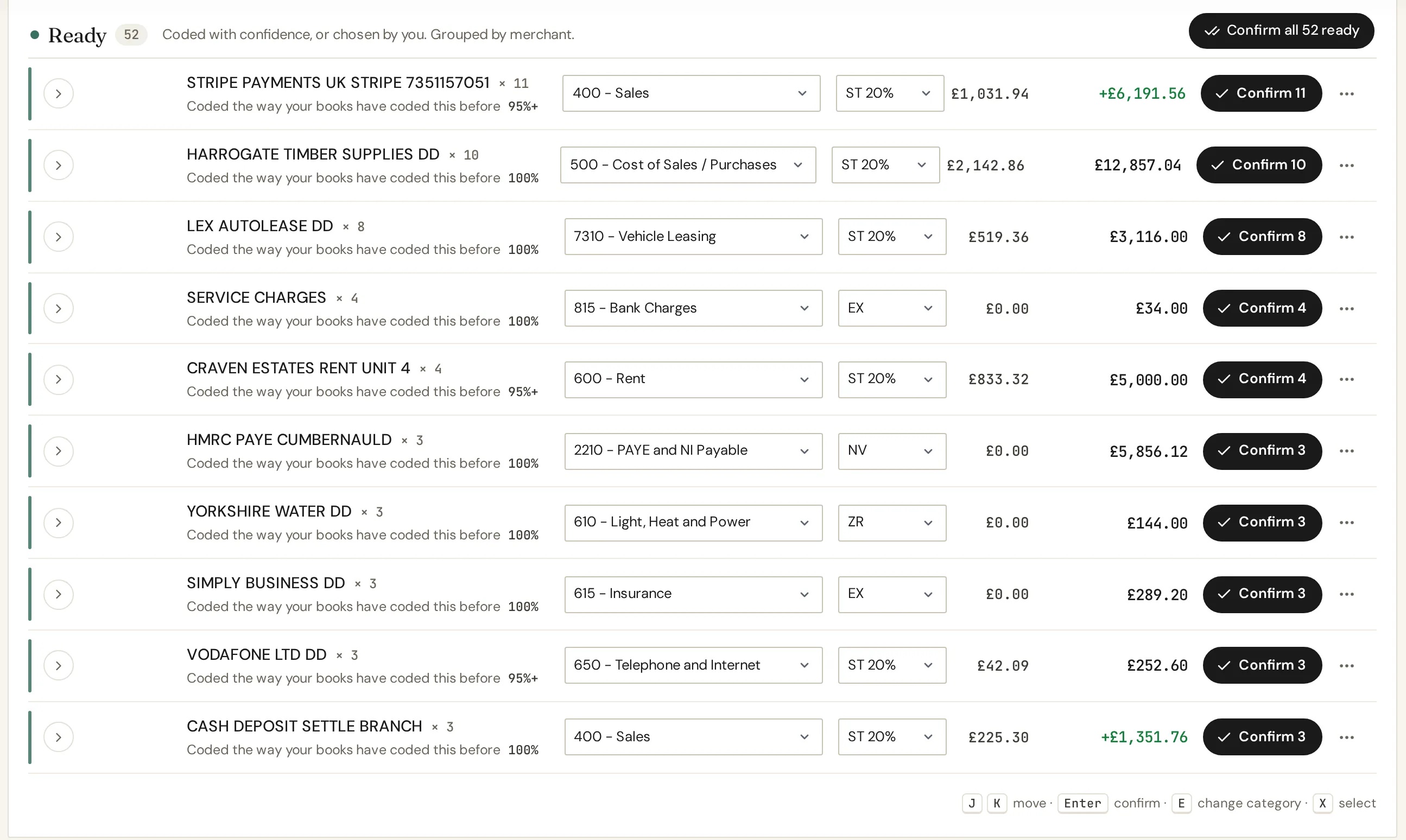
In IQ Books, raising an invoice posts the debtor, the sale and the VAT on the invoice date; matching the customer's payment to it posts the bank and clears the debtor. Coding a bank line posts the bank and the account you choose. Manual journals are there for the adjustments that have no document, such as depreciation or an accrual. The trial balance, profit and loss and balance sheet all read from the same ledger, and the general ledger report lets you trace any balance back to the entries behind it. One organisation with the whole ledger is free.
A useful review routine
- Keep the document or evidence behind each entry.
- Confirm whether it is a sale, expense, asset, liability, transfer or owner movement.
- Use the right date and account.
- Match settlements to existing invoices or bills.
- Reconcile the bank and investigate unusual balances.
- Review the profit and loss alongside the balance sheet.
The example is deliberately VAT-free. A VAT-registered transaction often introduces another ledger account; loans, payroll, accruals and capital purchases also need their own treatment. The aim is a reliable explanation of each movement, not merely a balancing total.
Once a month, three questions catch most problems: does the bank balance in the books match the statement; do the debtor and creditor balances match what customers and suppliers say; and is there any account with a balance on the "wrong" side, such as a credit on an expense or a debit on sales? A wrong-side balance is nearly always a reversal or a misposting. Our guides to the month-end close and management accounts pick up from there.
Try IQ Books free
Invoices, bills, bank feeds and VAT returns that make their own double entries, with the trial balance, profit and loss and balance sheet always up to date. Free for one organisation.
Try IQ Books freeFrequently Asked Questions
A method that records equal total debits and credits for each transaction, showing both sides of the movement between accounts.
They are the two sides of every entry. A debit increases assets, expenses and drawings and reduces liabilities, income and capital; a credit does the opposite. Every transaction has debits and credits of equal total.
No. A debit can increase an asset, increase an expense or reduce a credit-balance account. Read it together with the account being used.
In your own books, money into the bank is a debit to the bank account, and money out is a credit. Your bank statement shows the opposite because it is written from the bank's point of view, where your balance is money it owes you.
Use DEADCLIC: Debits increase Expenses, Assets and Drawings; Credits increase Liabilities, Income and Capital. Then remember that money into the bank is a debit in your books.
For real accounts, debit what comes in and credit what goes out. For personal accounts, debit the receiver and credit the giver. For nominal accounts, debit expenses and losses and credit income and gains. They give the same results as DEADCLIC.
Assets equal liabilities plus capital. Everything the business owns was funded either by what it owes or by the owner, including retained profit. Every correct double entry keeps the equation in balance.
A list of the balance on every ledger account, with debits in one column and credits in the other. If the totals differ, an entry is one-sided or mistyped. Income and expense balances then form the profit and loss account, and the rest form the balance sheet.
No. Duplicate, missing or misclassified transactions can still leave debits equal to credits. Reconciliation and review remain necessary.
No. The invoice records the sale; the payment settles the customer balance. Match the payment to the invoice.
Single entry lists money in and out, usually in one cash book. Double entry records every transaction in two accounts, so it also shows what the business is owed, what it owes and what it owns, and it has a built-in arithmetic check.
Not to record everyday transactions, because the software makes both entries when you raise an invoice, enter a bill or code a bank line. Knowing the rules helps you pick the right account and spot when a balance looks wrong.