What are management accounts? A worked example from a real ledger, and a free pack
A useful pack explains what changed and what to do next. Follow a fictional manufacturer from its ledger to a monthly pack, including the two months where profit rose and cash fell, with every number available to download.

"We made money in March. Where is it?"
Kestrel Precision Engineering Ltd is a fictional machine shop with 55 accounts in its ledger and a financial year to 31 March 2026. Its March was its best month of the year: sales of £152,870 and an operating profit of £26,130. Yet the current account finished March £16,225 lower than it started, and February had done the same, £32,321 down on a profit of £21,085. A director looking only at the profit and loss would have had a good spring. A director looking at a proper set of management accounts would have seen £123,122 of new customer debt building up over those two months and picked up the phone.
That is what management accounts are for. Not a smaller version of the year-end accounts, but a monthly set of reports that tells the people running the business what changed, why, and what to do about it.
Quick answer
Management accounts are internal reports, usually monthly, that show a business's profit and loss, balance sheet and cash position with comparisons and a short commentary, so the owners can act during the year rather than after it. Unlike statutory financial accounts they have no required format, no filing deadline and no legal obligation, which is why their value depends on reconciled books, consistent classification and a commentary that ends in decisions.
- A pack is profit and loss, balance sheet, cash, a comparison and a commentary; the commentary is the part most packs leave out.
- Profit and cash move separately: in our worked example, two months of £47,215 operating profit came with a £48,546 fall in the bank.
- Build the pack from the transaction-level general ledger, after the bank is reconciled and the month-end journals are in.
What are management accounts?
Management accounts are the regular reports you use to run a business: profit and loss, a balance sheet, cash movements and a short explanation of what changed. A useful pack connects the figures to a decision. A profit increase alongside overdue invoices calls for a different response from an increase backed by cash in the bank.
Their purposes fall into four groups:
- Steering. Spotting a falling margin, a rising overhead or a slow-paying customer while there is still time to act.
- Planning. Comparing actual results with a budget or forecast, and updating the forecast when reality moves.
- Funding. Banks and asset-finance lenders often ask for management accounts under loan conditions, and investors expect them in a board pack.
- Tax and year-end planning. Seeing the likely profit before the year closes, while decisions about investment, dividends and pension contributions can still change the outcome.
No law requires a company to prepare management accounts. The Companies Act requires every company to keep accounting records that show its money received and spent and its assets and liabilities, and a company that keeps those records properly has everything it needs to produce management accounts. Whether it does is a management choice, and most businesses past the first year or two find they cannot run without them.
A management accounts example you can check
Kestrel Precision Engineering Ltd is our fictional demo manufacturer. We ran its published general ledger through LedgerIQ's real import engine: 55 accounts and 1,150 transactions. The financial year is 1 April 2025 to 31 March 2026. This worked P&L is calculated from those parsed entries; it is not a customer case study or a claimed return on investment.
Download the worked Excel pack and the underlying general ledger CSV. The workbook includes every transaction and an account-movement tie-out. It is an explanatory companion, not a LedgerIQ board-pack export.
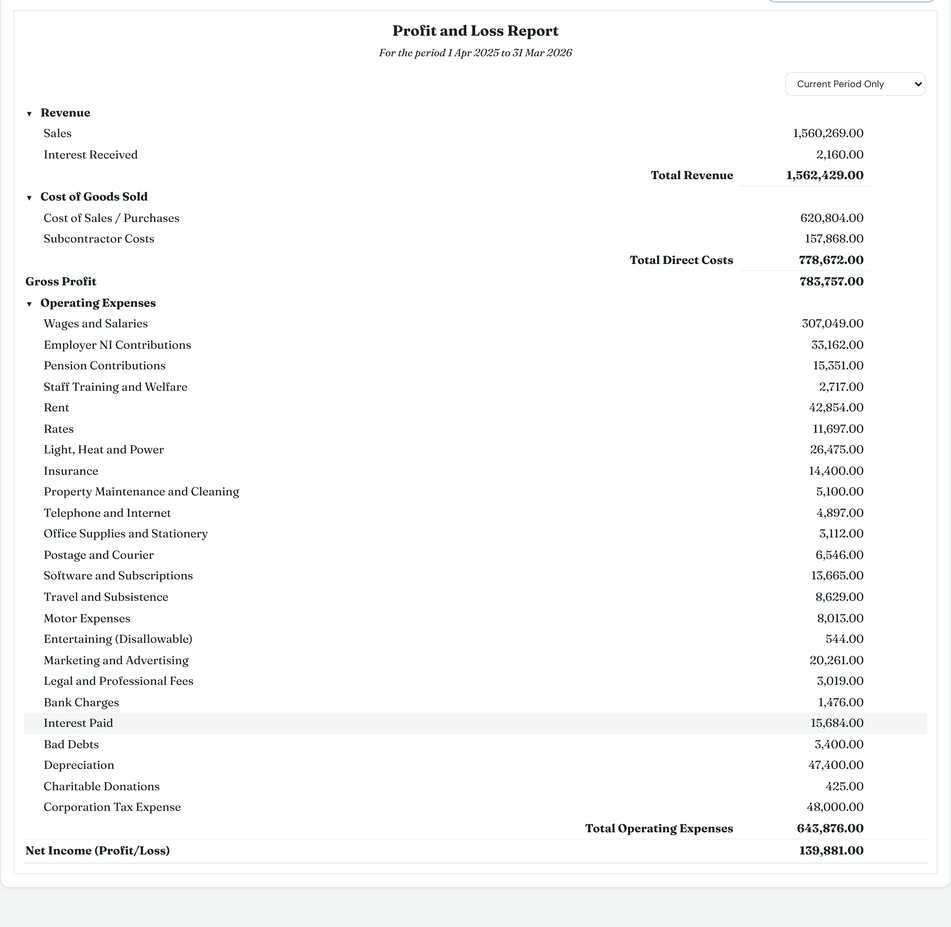
| Profit and loss | Year total |
|---|---|
| Sales | £1,560,269 |
| Direct costs | £778,672 |
| Gross profit | £781,597 |
| Operating expenses | £580,192 |
| Operating profit | £201,405 |
| Interest received | £2,160 |
| Interest paid | £15,684 |
| Profit before tax | £187,881 |
| Tax charge recorded in the sample | £48,000 |
| Profit after tax | £139,881 |
Read the movement, not just the total
Sales of £1,560,269 less direct costs of £778,672 leave £781,597 gross profit: 50.1% of sales. Direct costs here mean purchases and subcontractors. Wages and other overheads sit below gross profit in this example; a different business may classify production labour within cost of sales. Compare like with like before comparing margins.
After operating expenses, the business has £201,405 operating profit. Interest received and paid take that to £187,881 before tax. The £48,000 tax charge is an entry in the sample ledger, not a tax calculation or a suggested rate. Profit after tax is £139,881. The next questions are whether margins hold month by month, which costs explain the movement, and whether customers have paid.
Here is the same year month by month, straight from the ledger. Overheads include depreciation, bad debts and donations and exclude interest and tax. The last two columns are the movement in the trade debtors account and in the current account.
| Month | Sales | Gross profit | GP % | Overheads | Operating profit | Debtors change | Cash change |
|---|---|---|---|---|---|---|---|
| Apr 2025 | 120,218 | 58,139 | 48.4 | 47,452 | 10,687 | -13,738 | 25,898 |
| May | 131,133 | 67,597 | 51.5 | 45,883 | 21,714 | 45,373 | -13,518 |
| Jun | 135,045 | 67,613 | 50.1 | 45,835 | 21,778 | 1,169 | 39,869 |
| Jul | 125,319 | 62,642 | 50.0 | 47,212 | 15,430 | -11,723 | 6,107 |
| Aug | 102,909 | 51,669 | 50.2 | 45,260 | 6,409 | -34,883 | 16,323 |
| Sep | 141,764 | 70,541 | 49.8 | 49,266 | 21,275 | 46,850 | 11,753 |
| Oct | 138,876 | 66,957 | 48.2 | 52,710 | 14,247 | 20,340 | 3,659 |
| Nov | 136,046 | 68,915 | 50.7 | 49,289 | 19,626 | -51,533 | 48,738 |
| Dec | 107,093 | 53,811 | 50.2 | 47,887 | 5,924 | -34,744 | 4,818 |
| Jan 2026 | 126,862 | 65,575 | 51.7 | 48,475 | 17,100 | 23,723 | 16,674 |
| Feb | 142,134 | 71,804 | 50.5 | 50,719 | 21,085 | 58,230 | -32,321 |
| Mar | 152,870 | 76,334 | 49.9 | 50,204 | 26,130 | 64,892 | -16,225 |
| Year | 1,560,269 | 781,597 | 50.1 | 580,192 | 201,405 | 113,957 | 111,776 |
Calculated from the Kestrel sample general ledger. Debtors include VAT; cash is the NatWest current account only. All figures in £ except GP %.
Three things stand out that the annual total hides. Gross margin is remarkably steady, between 48.2% and 51.7% every month, so pricing and purchasing are under control. Overheads are close to fixed at £45,000 to £53,000 a month, which means operating profit swings almost entirely with sales: the two weak months, August and December, are the holiday months, and they earned £6,409 and £5,924. And the last two columns rarely move together.
When profit rises and cash falls
Look at February and March together. Operating profit was £47,215 across the two months. Over the same two months, trade debtors rose by £123,122 and the current account fell by £48,546. Nothing went wrong in the profit and loss; customers were simply invoiced for a strong run of work and had not yet paid for it. November shows the opposite: debtors fell by £51,533 as earlier invoices were collected, and cash rose £48,738 on a profit of £19,626.
This is the single most useful thing a monthly pack does for an owner-managed business, and the reason a profit and loss on its own is not a set of management accounts. A pack that showed only the profit line would have reported February and March as good news. A pack with a balance sheet and a cash bridge shows that the business funded £123,122 of customer credit in eight weeks, and prompts the obvious questions: which customers, how old are the invoices, and is anyone past terms?
A simple cash bridge for the two months makes the point on one line each:
| February and March 2026 | £ |
|---|---|
| Operating profit | 47,215 |
| Increase in trade debtors (including VAT) | (123,122) |
| Other movements: depreciation added back, VAT, creditors, loans, interest and timing | 27,361 |
| Change in the current account | (48,546) |
The "other movements" line is where a real pack splits out VAT paid, supplier payments, loan repayments and asset purchases. Even at this level of summary the message is clear.
What should a monthly management accounts pack include?
| Report | Question to answer | Evidence to keep |
|---|---|---|
| Profit and loss | Are sales and margins moving as expected? | Current month, prior month and year-to-date ledger |
| Balance sheet | What does the business own and owe? | Reconciled account balances and supporting schedules |
| Cash bridge | Why is profit different from cash? | Bank movements, debtor/creditor changes, loans and assets |
| Budget comparison | Where did the plan miss? | A separately approved budget and the same account mapping |
| Commentary | What should happen next? | Named action, owner and next review date |
An actual-versus-budget column is only meaningful when there is an agreed budget. The Kestrel download contains historical ledger data, so it does not invent a budget or turn last year's profit into a cash forecast. For planning, use the separate cash-flow forecast template.
Larger packs add an aged debtors and aged creditors report, a short cash flow forecast for the next 13 weeks, key ratios, and, for businesses with distinct products, departments or jobs, a margin by line. Keep the core pack short enough to read in ten minutes. A twenty-page pack that nobody reads does less than a three-page pack that ends in three decisions.
The numbers worth watching
A handful of ratios turn the reports into something a director can scan. Here they are for Kestrel at 31 March 2026, with the method, because a ratio without its method cannot be compared month to month. Our guide to financial ratios for small businesses covers more.
| Measure | Kestrel | How it is calculated here |
|---|---|---|
| Gross margin | 50.1% | Gross profit ÷ sales, year |
| Operating margin | 12.9% | Operating profit ÷ sales, year |
| Debtor days | 48 days | Trade debtors ÷ (last 3 months' sales × 1.2 for VAT) × 90. On full-year sales it would read 53 days |
| Stock days | 87 days | Closing stock of £148,292 ÷ purchases × 365 |
| Creditor days | 41 days | Trade creditors of £104,688 ÷ (purchases and subcontractors × 1.2) × 365, approximate |
| Interest cover | 12.8 times | Operating profit ÷ interest paid |
The debtor days line shows why the method matters. The same balance gives 48 days or 53 days depending on which sales you divide by. Using the most recent quarter reflects the current pace of trading; using the year smooths seasonality. Either is fine, as long as next month uses the same one.
A worked commentary for March 2026
Trading. Sales of £152,870 were the highest of the year and 7.6% above February; gross margin held at 49.9%. Operating profit was £26,130, taking the year to £201,405. Cash. The current account fell £16,225 in March after £32,321 in February, because trade debtors rose £123,122 over the two months to £271,957. Actions. (1) Credit control to review every invoice over 45 days old by 10 April; (2) confirm the three largest February invoices are not disputed; (3) hold the planned machinery purchase until debtor days are back under 45. Next review: April pack, 12 May.
Every sentence in that commentary is either a number from the ledger or a named action. That is the standard to aim for.
How to prepare management accounts from a general ledger
- Choose a consistent reporting period and reconcile the bank.
- Review unpaid invoices, supplier balances, stock and cut-off. Record supported adjustments before analysing.
- Export the transaction-level general ledger with dates, accounts, descriptions and debit/credit amounts.
- Check that totals tie to the source accounts, then compare margins, overheads and working capital.
- Write a short commentary with actions. Have the responsible person review the pack before circulating it.
Step 2 is where monthly accounts most often go wrong, because the year-end adjustments an accountant makes once a year need to happen, in a lighter form, every month:
- Depreciation posted monthly. Kestrel posts £3,950 a month; leaving it to the year end overstates eleven months of profit and understates the twelfth.
- Accruals for costs incurred but not yet invoiced: energy, subcontractors, the accountant's fee.
- Prepayments released monthly. Kestrel's £14,400 of prepaid insurance comes through at £1,200 a month, not in one lump.
- Stock: a count, or at least a reasoned estimate, if stock is material. Kestrel's stock rose £16,292 over the year to £148,292, and a margin that ignores that movement is wrong.
- Payroll journals that match the payroll report, with employer's NI and pension in the right month.
LedgerIQ's financial analysis and management accounts tools read the general ledger, not just a trial balance. After signing in, choose "See it work on sample data" to explore this fictional company without spending credits. An analysis of your own ledger costs 1,000 credits.
Management accounts versus financial accounts
Management accounts support internal decisions throughout the year. Statutory financial accounts follow the applicable reporting rules for the year end and external recipients. An internal pack does not replace that process. Likewise, a profit and loss template alone is not a full management pack: the balance sheet, cash position and commentary explain what the profit figure leaves out.
| Management accounts | Financial (statutory) accounts | |
|---|---|---|
| Purpose | Run the business during the year | Report to shareholders, HMRC and the public |
| Audience | Directors, managers, lenders on request | Members, Companies House, HMRC |
| Frequency | Monthly or quarterly, as the business chooses | Once a year |
| Format | Whatever is useful: any layout, any level of detail | Set by the Companies Act and FRS 102 or FRS 105 |
| Legal requirement | None | Required for every company |
| Deadline | Set internally, often within 10 to 15 working days | 9 months after the year end for a private company |
| Forward-looking | Often: budgets, forecasts, actions | No: historical only |
| Precision | Reasonable estimates are fine if they are labelled | Finalised figures, reviewed and signed |
The two should agree in the end. A good test of a year's management accounts is how small the adjustments are when the statutory accounts are prepared. If March's pack said £201,405 and the year-end accounts say £160,000, the monthly process missed something, usually stock, accruals or depreciation. For the statutory side of a small company, see our guide to micro-entity accounts.
Examples of management reports
"Management accounts" is the core pack, but most businesses grow a few extra reports around it. The common ones, and the question each answers:
| Report | Answers |
|---|---|
| Budget versus actual (variance report) | Where did we beat or miss the plan, and by how much? |
| 13-week cash flow forecast | Will we have enough cash for payroll, VAT and the loan in each of the next 13 weeks? |
| Aged debtors | Who owes us money, and how overdue is it? |
| Aged creditors | Who do we owe, and what falls due this month? |
| Job, product or department profitability | Which work actually makes money once direct costs are allocated? |
| KPI dashboard | Are the handful of measures that matter moving the right way? |
| Break-even analysis | How much do we need to sell each month to cover fixed costs? |
Kestrel's break-even is a useful example of the last one. With overheads of roughly £48,000 a month and a 50% gross margin, the business needs about £96,000 of sales a month to cover its costs before interest, which is why the £102,909 August and £107,093 December were thin months rather than loss-making ones.
Who prepares management accounts, and with what?
In a small business the bookkeeper usually keeps the ledger and an external accountant or an in-house finance person turns it into the monthly pack. The work divides into the close (reconciliations and journals), the reporting (the reports themselves) and the interpretation (the commentary). Software has largely taken over the reporting; the close and the interpretation still need a person who knows the business.
Within ReconcileIQ the work splits across two products. IQ Books keeps the ledger itself and runs the profit and loss, balance sheet, trial balance and aged debtors from the live books, with budgets and variance as an optional module, on the free plan. LedgerIQ takes the transaction-level general ledger from IQ Books or any other accounting system and runs the analysis on top: ratios, trends, cash conversion, anomaly checks across 44 modules and a board pack you can export, for 1,000 credits per analysis. A trial balance is not enough for it, because it reads the individual transactions to see timing and patterns within each account.
Whatever the tool, the pack is only as good as the close that comes before it. Reconcile the bank first; our bank reconciliation template covers the mechanics.
Explore LedgerIQ
Ratios, trends, cash conversion and a board pack from your general ledger. Try it on the Kestrel sample data without spending credits.
Explore LedgerIQQuestions and answers
Regular internal reports that explain profit, financial position and cash, usually with comparisons and actions. The format depends on the decisions the business needs to make.
They are monthly or quarterly internal reports, typically a profit and loss, balance sheet, cash summary and commentary. Their purposes are to steer the business during the year, compare results with a budget or forecast, give lenders and investors the information they ask for, and plan tax and year-end decisions before the year closes.
Management accounts are internal, as frequent as you like, in any format and not legally required. Financial (statutory) accounts are prepared once a year in the format set by the Companies Act and FRS 102 or FRS 105, go to members, Companies House and HMRC, and every company must prepare them.
Monthly is a useful starting point for many businesses. Match the frequency to the decisions and the quality of available records; do not publish a polished pack from unreconciled books.
At minimum a profit and loss for the month and year to date, a balance sheet, an explanation of why cash moved differently from profit, a comparison with budget or the prior period, and a short commentary ending in named actions. Many packs add aged debtors and creditors, a cash flow forecast and a few key ratios.
Common management reports include budget versus actual variance reports, 13-week cash flow forecasts, aged debtors and creditors, job or product profitability, KPI dashboards and break-even analysis, alongside the core profit and loss and balance sheet.
No. Companies must keep adequate accounting records and prepare annual statutory accounts, but there is no legal requirement to prepare management accounts. Lenders often make them a condition of a loan, however, and most growing businesses need them to run day to day.
Yes: the Excel pack linked in this guide is a worked management accounts example built from a fictional manufacturer's ledger, with every transaction and an account-movement tie-out. Use its structure, but build your own pack from your reconciled ledger.
No. LedgerIQ needs transaction-level general ledger data so it can examine timing, descriptions and movements within each account.
No. Kestrel is a fictional demo company. Its downloadable ledger was processed by the real LedgerIQ import engine; the Excel companion shows calculations from those entries.