Micro-entity accounts: what they are, the thresholds, a worked example and filing
The smallest set of statutory accounts a UK company can file, and the most misunderstood. Here are the limits that decide who qualifies, a complete sample balance sheet, the filing rules and the working papers that still sit behind every figure.

"Can we just file the micro accounts?"
Take Priya, who runs Calder Valley Signs Ltd from a unit in Hebden Bridge with six staff and a van. Her year ended on 31 March 2026. In July her bookkeeper sends the year-end pack to the practice with a note: "Turnover is £540k, so micro accounts as usual?" The answer is yes, but not for the reason in the note, and the reason matters. The company's year began on 1 April 2025, five days before the new, higher size limits took effect, so this year is tested against the old limits of £632,000 turnover and £316,000 on the balance sheet. It passes comfortably. A neighbour with £700,000 of turnover and the same year end would not have been a micro-entity for this year, whatever the headlines about £1 million said.
That is the pattern with micro-entity accounts. The published document is short, and the rules about who can use it, what goes in it and where it goes are where the mistakes happen.
Quick answer
Micro-entity accounts are the simplest statutory accounts a UK company can prepare, under FRS 105. A company qualifies if it meets two of three tests: turnover of £1 million or less, a balance sheet total of £500,000 or less and 10 or fewer employees, for periods beginning on or after 6 April 2025 (before that, £632,000 and £316,000). Companies House receives only the balance sheet and a few notes, but HMRC still gets full accounts with the Company Tax Return, and the records behind the figures are the same as for any company.
- The thresholds that apply depend on when the accounting period began, not when you prepare the accounts.
- Private companies have 9 months from the year end to file; a late set costs at least £150.
- From 1 April 2028 micro-entities must deliver a profit and loss account to Companies House, and only software filing will be accepted.
- Simpler presentation does not mean simpler records: every balance still needs a working paper behind it.
What are micro-entity accounts?
Micro-entity accounts are a simplified statutory reporting option for eligible very small companies. "Small" in everyday language is not enough: check the legal size tests, eligibility exclusions and the relevant accounting period. The reduced presentation does not remove the need for complete records or a defensible year-end close.
In practice the regime gives a qualifying company three things. It can prepare a much shorter balance sheet, using a format with only a handful of headings instead of the detailed formats bigger companies use. It needs only a handful of notes, which sit at the foot of the balance sheet. And it can deliver just that balance sheet and those notes to Companies House, keeping the profit and loss account off the public record (until 1 April 2028, when that changes; more below). The accounts are prepared under FRS 105, the Financial Reporting Standard applicable to the Micro-entities Regime, and the Companies Act presumes accounts that meet the micro-entity minimum requirements give a true and fair view, so no extra disclosures are needed to get there.
The regime is optional. A company that qualifies can choose to prepare small company accounts under FRS 102 Section 1A instead, and some do, for reasons covered further down.
Check eligibility for the period you are preparing
The current GOV.UK guide lists a turnover limit of £1 million, balance-sheet total of £500,000 and 10 employees, with two of the three tests required. Period and transition rules matter; do not apply today's headline limits automatically to an earlier year. Confirm eligibility, including exclusions and consecutive-year rules, before choosing the regime.
Companies House's Life of a company guidance sets out both sets of limits side by side, and the dividing line is the date the accounting period begins:
| Test (meet at least 2 of 3) | Periods beginning on or after 6 April 2025 | Periods beginning 30 Sept 2013 to 5 April 2025 |
|---|---|---|
| Turnover | £1,000,000 or less | £632,000 or less |
| Balance sheet total | £500,000 or less | £316,000 or less |
| Average number of employees | 10 or fewer | 10 or fewer |
Source: Companies House, Life of a company, part 1, section 9.1, checked 11 October 2026.
Three details catch people out. First, the balance sheet total means total assets before deducting any liabilities: fixed assets plus current assets. A company with £600,000 of assets and £450,000 of loans has net assets of £150,000 but fails the balance sheet test. Second, the employee figure is the average number employed across the year, not the head count on the last day, and directors employed under a contract of service count. Third, the turnover limit is for a 12-month period; a longer or shorter first period scales it proportionately.
The two-year rule
A company qualifies in its first financial year if it meets the conditions in that year. After that, it generally has to meet them in the year and the year before. The rule cuts both ways: a company that grows past the limits for one year keeps the exemptions for that year and only loses them if it misses again the next year, and a company that shrinks back does not become a micro-entity until it has met the tests twice. When a client's numbers sit near the limits, look at two years of figures, not one.
Companies that cannot use the micro-entity regime
Size is not the only gate. Companies House lists the companies that cannot prepare and file micro-entity accounts if they were, at any time in the year:
- a public limited company, an overseas company or an unregistered company;
- a charitable company;
- a company authorised to register under section 1040 of the Companies Act 2006, or one excluded under section 384 or 384B (broadly, financial-services businesses such as authorised insurers and banks);
- a parent company of a group that is not a small group, or a parent of a small group that prepares consolidated accounts;
- a subsidiary whose accounts are included in consolidated group accounts.
Limited liability partnerships have their own micro-entity regime with equivalent rules, so an LLP that meets the size tests can use it too.
Micro-entity, small, abridged or full: which accounts are which?
"Micro accounts", "abridged accounts" and "filleted accounts" get used as if they mean the same thing. They do not. The first is a way of preparing accounts; the others are ways of filing a set of small company accounts. FRS 102 Section 1A is the small company version of the full standard.
| Type | Who can use it | Standard | What Companies House gets | What members and HMRC get |
|---|---|---|---|---|
| Micro-entity accounts | Micro-entities | FRS 105 | The micro balance sheet and its notes | Balance sheet, profit and loss and notes |
| Small accounts, filleted | Small companies (micro-entities too) | FRS 102 Section 1A | Balance sheet and notes; profit and loss and directors' report left off | Full small company accounts |
| Abridged accounts | Small companies, if all members agree | FRS 102 Section 1A | A shortened balance sheet (and optionally a shortened profit and loss) | Abridged versions sent to members as well |
| Full accounts | Any company | FRS 102 (or IFRS) | Everything, including the profit and loss and directors' report | Everything |
The practical difference between micro and small comes down to measurement as much as presentation. FRS 105 keeps everything at historical cost: no revaluing a property, no fair value for investments, and no deferred tax. It also expenses development costs and borrowing costs that a larger company might capitalise. For most trading companies with a van, some equipment and a bank account none of that changes the numbers. For a company that owns an investment property or holds shares it wants to show at market value, it changes them a lot, and FRS 102 Section 1A is the better fit even though the company could choose the micro regime.
The FRC's Periodic Review 2024 amendments apply to FRS 105 for accounting periods beginning on or after 1 January 2026, so a set of micro accounts for a period starting in 2026 is prepared under the updated edition of the standard. Check the transition requirements for revenue in particular if a client invoices long contracts in stages.
What goes into micro-entity accounts
The legal minimum is short. Companies House lists it as a balance sheet in one of the specified formats, any notes the regulations require, and an auditor's report unless the company claims audit exemption, which nearly every micro-entity does. In practice a complete set for a typical micro-entity contains:
- A balance sheet in the micro-entity format, with the comparative figures for the previous year.
- A profit and loss account for the members and HMRC. It is part of the statutory accounts even though, for now, it does not have to be filed at Companies House.
- Notes at the foot of the balance sheet on advances, credit and guarantees granted to directors, and on financial commitments, guarantees and contingencies not shown on the balance sheet, plus the average number of employees.
- The statements above the director's signature: the audit exemption statements and the micro-entity statement.
The micro-entity statement is not optional wording. Companies House requires the balance sheet to state, in a prominent position above the director's signature and printed name, that "The accounts have been prepared in accordance with the micro-entity provisions and have been delivered in accordance with the provisions applicable to companies subject to the small companies regime." It must also appear in the accounts sent to members, not only in the copy filed.
A micro-entity accounts example: Calder Valley Signs Ltd
Here is the balance sheet Priya's company might file, laid out the way a micro-entity balance sheet usually appears. The company and every figure are fictional; the layout and the statements follow the micro-entity rules described above. Use it as a sample of the format, not as a template to fill in without checking your own facts.
Calder Valley Signs Ltd: balance sheet as at 31 March 2026
| 2026 £ | 2025 £ | |
|---|---|---|
| Fixed assets | 64,200 | 58,900 |
| Current assets | 221,400 | 186,300 |
| Prepayments and accrued income | 4,100 | 3,600 |
| Creditors: amounts falling due within one year | (78,600) | (71,200) |
| Net current assets | 146,900 | 118,700 |
| Total assets less current liabilities | 211,100 | 177,600 |
| Creditors: amounts falling due after more than one year | (22,000) | (30,000) |
| Net assets | 189,100 | 147,600 |
| Capital and reserves | 189,100 | 147,600 |
Notes. (1) The average number of employees during the year, including directors, was 7 (2025: 7). (2) Advances to directors: during the year the company made an interest-free advance to a director; £3,400 was outstanding at 31 March 2026 (2025: nil). (3) Financial commitments: the company is committed to rent on its premises totalling £18,000 under a lease ending in March 2027, not included in the balance sheet.
Statements. For the year ending 31 March 2026 the company was entitled to exemption from audit under section 477 of the Companies Act 2006 relating to small companies. The members have not required the company to obtain an audit in accordance with section 476. The directors acknowledge their responsibilities for complying with the requirements of the Act with respect to accounting records and the preparation of accounts. The accounts have been prepared in accordance with the micro-entity provisions and have been delivered in accordance with the provisions applicable to companies subject to the small companies regime.
Approved by the board on 14 July 2026 and signed on its behalf by P. Sharma, Director.
Two things about this sample are worth noticing. The balance sheet total for the size test is £289,700 (fixed assets, current assets and prepayments added together, before creditors), which is under the old £316,000 limit that applies to this year. And the director's advance is a disclosure, not just a number: if it is still outstanding nine months and a day after the year end, it also brings a section 455 tax charge into the Corporation Tax return, which is the kind of point a working paper exists to catch.
A working-papers example: a repair bill that arrived late
Here is a deliberately small fictional example. A company has a 31 March year end. Repair work of £1,200 was completed on 28 March; the supplier invoice arrived on 5 April. Assume the repair is an expense, the business is not VAT registered, and the cost has not already been recorded. The year-end schedule records the evidence and proposes the adjustment:
| Working-paper field | Example |
|---|---|
| Evidence | Supplier invoice dated 5 April and completion record dated 28 March |
| Period decision | Work completed before the year end |
| Debit | Repairs expense £1,200 |
| Credit | Accruals £1,200 |
| Profit effect | Profit before tax falls by £1,200 |
| Cash effect at year end | None: the supplier has not yet been paid |
| Following-period control | Reverse or release the accrual when the invoice is booked; avoid counting it twice |
| Review | Preparer and reviewer record their conclusion and unresolved questions |
This is an illustrative working-paper schedule, not a statutory accounts template, a PrepIQ export or a tax computation. The reviewer still checks the invoice, dates and treatment. A capital item, a VAT-registered business or an invoice already entered in the ledger would require a different assessment.
On the micro-entity balance sheet the £1,200 disappears into a single line. Accruals can be shown within "Creditors: amounts falling due within one year" or on their own line as accruals and deferred income; either way nobody reading the filed accounts will ever see the repair bill. That is exactly why it needs to be on a schedule: the published accounts are too condensed to show whether the cut-off was right, so the evidence has to live somewhere else.
What are working papers, and how do they support micro-entity accounts?
Working papers connect the records to the final trial balance. A bank schedule agrees the ledger to statements; a debtor schedule explains unpaid customers; an asset schedule supports cost and depreciation; an accrual schedule records costs belonging to the year. Each balance needs an explanation, supporting evidence and a review trail.
| Area | Useful year-end evidence |
|---|---|
| Bank | Statement, reconciliation and outstanding items |
| Sales and debtors | Aged list, credit notes, later receipts and cut-off |
| Suppliers and accruals | Aged creditors, later invoices and unrecorded liabilities |
| Fixed assets | Invoices, disposals, depreciation policy and roll-forward |
| Loans and directors | Statements, agreements and movements |
| Tax and review | Tax working, questions, adjustments and reviewer sign-off |
The micro-entity regime changes none of this. The size of the published document is decided by the regime; the size of the file behind it is decided by the records. A one-page balance sheet with £221,400 of current assets still needs a bank reconciliation that ties to the penny, a debtor list that explains every unpaid customer, and a stock figure someone can defend. HMRC sees the full profit and loss with the tax return, and an enquiry starts from the records, not from the filed balance sheet.
For a typical micro-entity the file usually runs to:
- an extended trial balance taking the ledger to the final figures, with every journal referenced;
- a bank reconciliation for each account at the year end;
- debtors and creditors schedules, including the cut-off test on invoices either side of the year end;
- a fixed asset register with additions, disposals and depreciation, and the capital allowances working that runs alongside it;
- a director's loan account reconciliation, because overdrawn balances drive both the disclosure note and the section 455 charge;
- VAT, PAYE and Corporation Tax control account reconciliations;
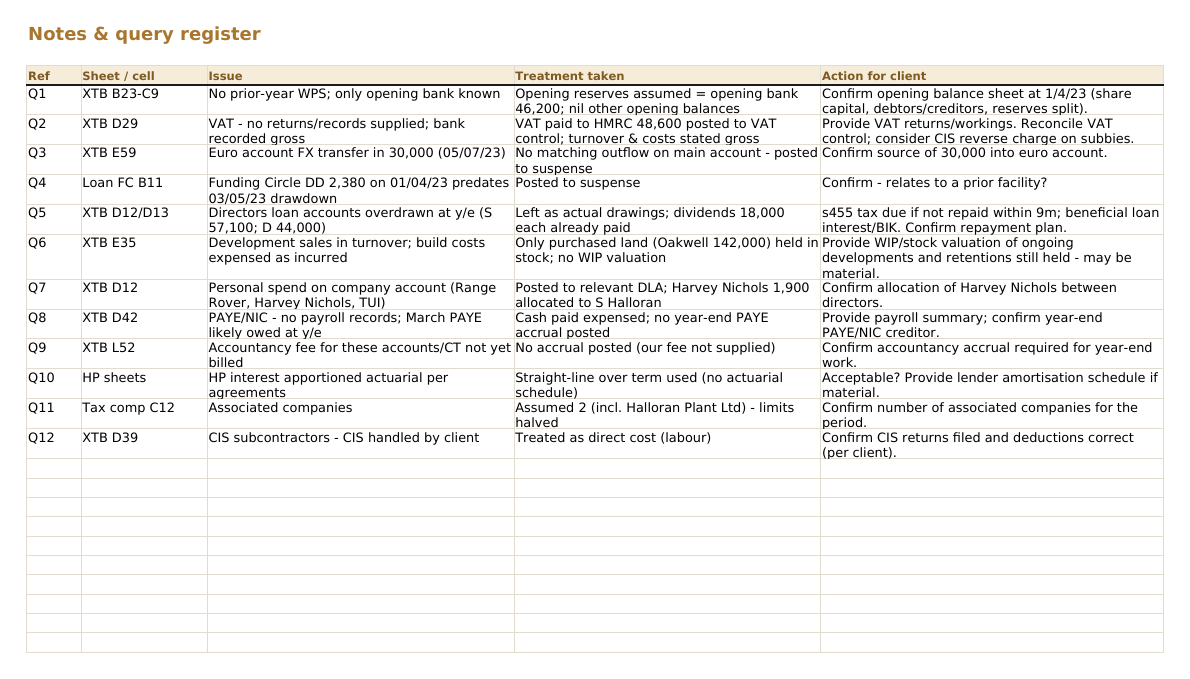
- a notes and queries register recording every judgement and every question for the client.
Filing micro-entity accounts with Companies House and HMRC
Micro-entity accounts go to two places, in two different forms. Companies House receives the balance sheet and notes for the public register. HMRC receives the full statutory accounts, profit and loss included, as part of the Company Tax Return. GOV.UK is explicit that a small company or micro-entity must still send statutory accounts to its members and to HMRC with the CT600, so "can you file micro-entity accounts with HMRC?" has a straightforward answer: yes, and you have to, but HMRC wants the full set rather than the filed extract, tagged in iXBRL. HMRC's free online service for filing accounts and the Company Tax Return together has closed, so the return now goes through commercial software.
Deadlines
A private company has 9 months from its accounting reference date to deliver acceptable accounts to Companies House, calculated to the exact day: a 30 April year end must be filed by midnight on 31 January. First accounts covering more than 12 months are due 21 months after incorporation, or 3 months after the accounting reference date if that is later. The Corporation Tax is normally payable 9 months and one day after the year end, and the return itself is due within 12 months.
Late filing penalties
| How late the accounts are | Private company penalty |
|---|---|
| Not more than 1 month | £150 |
| More than 1 month, not more than 3 months | £375 |
| More than 3 months, not more than 6 months | £750 |
| More than 6 months | £1,500 |
Source: Companies House, Life of a company, part 1, section 6. Late filing is also a criminal offence for the directors, separate from the penalty on the company.
Accounts that are rejected after the deadline count as late, and there is no extra time for a resubmission. Filing a week early, not on the last afternoon, is the cheapest insurance there is.
What changes in 2028
Two changes from the Economic Crime and Corporate Transparency Act reforms land on 1 April 2028. Companies House will accept accounts only through commercial software in iXBRL format, so WebFiling and paper filing end for accounts. And micro-entities will have to deliver their profit and loss account to Companies House too, with an option, still being finalised, to stop it being published on the register. If a client chose the micro regime mainly to keep its turnover private, that is worth a conversation now rather than in 2028.
Should a company use the micro-entity regime?
For most qualifying trading companies, yes. It is less work to prepare, less to file, and it keeps commercial detail off the public record. But there are honest reasons to choose small company accounts under FRS 102 Section 1A instead:
| Consideration | Micro-entity (FRS 105) | Small company (FRS 102 1A) |
|---|---|---|
| Preparation effort | Lowest: short formats, minimal notes | More notes and accounting policies |
| Property and investments | Historical cost only, no revaluation | Can show investment property and listed shares at fair value |
| Deferred tax | Not recognised | Recognised |
| Development and borrowing costs | Always expensed | Can be capitalised in some cases |
| What outsiders can see | Very little; lenders and credit checks have less to go on | More, if the company chooses to file it |
| Profit and loss at Companies House | Not filed until 1 April 2028 | Optional to file (filleted) |
The credit point is the one clients notice. A supplier or lender looking at a micro-entity balance sheet sees net assets and almost nothing else, and some will ask for management accounts or the full set before extending credit. A company about to raise finance may prefer to publish more, not less. Equally, a company that owns its building and wants the balance sheet to show what it is worth should not be on FRS 105.
Where PrepIQ fits
PrepIQ prepares year-end working papers from the client records for the practice to review. The signed-off trial balance and supporting schedules then feed the statutory accounts process. Do not confuse a working-papers pack with an approved set of accounts or a filing acknowledgement.
A PrepIQ job takes the client's ledger, bank statements and documents and builds the file described above: the extended trial balance, fixed asset and capital allowances schedules, loan and hire purchase workings, the tax computation, a completion statement and the notes and queries register. Where the records fall short it says so in the register rather than guessing. The practice reviews it, answers the queries, and takes the adjusted trial balance into its accounts production software to produce the micro-entity accounts themselves.
PrepIQ is live on Practice Essential and above. A year-end job uses 5,000 credits with the default RiQ engine or 10,000 at maximum; Ask RiQ revisions use 1,250 or 2,500. Open the app to assemble the records, brief and supporting documents. The practitioner remains responsible for resolving questions and approving the result.
PrepIQ works for UK and Irish companies: the practice sets its tax jurisdiction in firm settings. A Northern Ireland company is a UK company for this purpose, filing at Companies House and with HMRC. A company in the Republic of Ireland follows the Companies Act 2014 and files with the CRO and Revenue, with its own size tests, so do not apply the UK limits above to it. For more on how AI-prepared working papers hold up in review, see can AI prepare year-end accounts?
Before signing off
- Confirm the correct reporting framework and eligibility for this period.
- Agree every material balance to the ledger and supporting evidence.
- Review the proposed journals and the adjusted trial balance.
- Resolve missing documents, estimates and unusual balances.
- Check the final accounts and filing requirements separately from the working papers.
- Check the director's loan account at the year end and nine months later, for the disclosure note and any section 455 charge.
- Make sure the micro-entity statement sits above the director's signature, in both the members' copy and the filed copy.
- Diary the Companies House deadline, the Corporation Tax payment date and the CT600 due date separately: they are three different days.
Rules checked against GOV.UK's company accounts guide and Companies House's Life of a company guidance on 11 October 2026. For the accounting framework, consult the FRC's FRS 105 material. Corporation Tax rates are on GOV.UK, and our Corporation Tax calculator works them through for a given profit.
Open PrepIQ
Year-end working papers built from the client's records, with every judgement in a query register for your review. Live on Practice Essential and above.
Open PrepIQQuestions and answers
A simplified statutory reporting option for eligible very small companies. Check the size tests, exclusions and accounting period before applying the regime.
For accounting periods beginning on or after 6 April 2025, a company must meet at least two of three tests: turnover of £1 million or less, a balance sheet total of £500,000 or less, and 10 or fewer employees on average. For periods that began between 30 September 2013 and 5 April 2025 the limits were £632,000 turnover and £316,000 balance sheet total, with the same 10 employees.
Micro-entity accounts are prepared under FRS 105 with a short balance sheet, a handful of notes and historical-cost measurement, and only the balance sheet and notes go to Companies House. Full accounts follow FRS 102 with complete notes, accounting policies and a directors' report, and everything is filed and published.
Yes, and you must: HMRC receives the full statutory accounts, including the profit and loss account, as part of the Company Tax Return, tagged in iXBRL. HMRC's free online service for filing accounts with the return has closed, so the CT600 and accounts now go through commercial software.
A typical set is a one-page balance sheet in the micro format (fixed assets, current assets, prepayments, creditors split by due date, net assets, capital and reserves), comparatives, notes on directors' advances, financial commitments and average employees, and the audit exemption and micro-entity statements above the director's signature. The worked example in this guide shows a complete fictional set.
A private company must deliver its accounts to Companies House within 9 months of its accounting reference date, calculated to the exact day. First accounts covering more than 12 months are due 21 months after incorporation or 3 months after the accounting reference date, whichever is later. Late filing penalties start at £150.
Micro-entity accounts are prepared under FRS 105 by companies that meet the micro size tests. Abridged accounts are a shortened filing option for small companies preparing accounts under FRS 102 Section 1A, and need the agreement of all members. A micro-entity uses its own short format and does not need to abridge.
Not yet at Companies House, although it is part of the statutory accounts sent to members and HMRC. From 1 April 2028 micro-entities will have to deliver the profit and loss account to Companies House as well, with an option to keep it off the public register.
Public companies, overseas and unregistered companies, charitable companies, certain financial-services companies excluded under sections 384 and 384B of the Companies Act 2006, parents of groups that are not small or that prepare consolidated accounts, and subsidiaries included in consolidated accounts.
HMRC does not use the Companies Act size tests for Corporation Tax. What matters there is profit: the small profits rate of 19% applies to profits of £50,000 or less, the main rate of 25% to profits over £250,000, and marginal relief in between, with the limits reduced for short periods and associated companies.
Schedules and evidence supporting the account balances, adjustments and conclusions used to prepare the final accounts.
No. Working papers explain and support the figures. Statutory accounts are the formal financial statements prepared under the applicable framework.
No. PrepIQ prepares the working papers for review. The practitioner resolves questions, checks adjustments and signs off the result.