Fathom Alternatives in 2026: Financial Analysis Without Per-Company Pricing
Fathom is excellent software. It also charges by the company, which adds up for practices that want to offer analysis across all their clients, not just the top five. Here are five alternatives, with every price checked in October 2026.

Quick answer
The main Fathom alternatives in 2026 are LedgerIQ, Spotlight Reporting, Futrli, Reach Reporting and, inside Xero, Xero Analytics, built on Syft. Fathom Pro costs $450 a month for 25 companies plus $17 for each extra, about $535 for 30 clients, and analyses summarised data synced from your accounting software. LedgerIQ reads the transaction-level general ledger from any platform, has 44 modules and the RiQ copilot, and charges 1,000 credits per full analysis, so 30 clients a month fit inside the £78 Practice Essential plan.
- Fathom Pro costs about $535 a month for 30 companies; ReconcileIQ's £78 practice plan covers 50 full LedgerIQ analyses a month.
- LedgerIQ reads transaction-level general ledger exports, so it can flag anomalies and duplicates that summary-level tools never see.
- Fathom, Spotlight and Reach consolidate groups of companies; LedgerIQ analyses one entity at a time.
Why Practices Are Looking Beyond Fathom
Fathom has been the go-to financial analysis and reporting tool for accountants since its early days as a Xero add-on. The dashboards are clean, the KPI tracking is solid, and the reporting templates look professional enough to hand straight to a client.
So why are practices searching for alternatives?
The core issue is scale. Fathom Pro is $450 a month for 25 companies, about $18 each, then $17 for every extra company. A practice offering analysis to 30 clients pays about $535 a month; at 60 clients it is about $1,045. A lighter Portfolio plan ($67 a month for 100 companies) gives a portfolio dashboard and summary reports rather than the full advisory suite.
Bundled pricing is fairer than the old flat per-entity fee, but the bill still rises with every client you add. Practices either:
- Limit analysis to premium clients only, creating a two-tier service that's hard to sell
- Absorb the cost, eroding margins on advisory services
- Pass it through, making their advisory package harder to sell
The other gap is depth. Fathom works with summarised account data synced from your accounting software, not raw transactions. It can tell you revenue went up, but not which transactions look anomalous, where a duplicate payment is hiding, or how seasonality shows up line by line.
Platform coverage is broader than it was: Fathom's pricing page lists Xero, QuickBooks Online and Desktop, MYOB, FreeAgent, Excel and Google Sheets. Sage is not on the list.
What to Look for in a Fathom Alternative
Not all financial analysis tools are created equal. Before evaluating alternatives, consider what actually matters for your practice:
- Data depth: does it work with summary-level data only, or can it analyse individual transactions? Transaction-level analysis enables anomaly detection, duplicate identification and granular trend tracking.
- Platform coverage: if you have clients on Sage, Pandle or other platforms a tool does not connect to, you need something that works from a general ledger export.
- Pricing model: per company, per connection, per licence or credit-based? Your cost at 5 clients and at 50 can differ enormously.
- Consolidation: if you report on groups of companies, check that the tool consolidates them.
- Client-ready reporting: can you produce board-quality PDF reports without an hour of reformatting?
- AI capabilities: can it explain findings in plain English for non-financial stakeholders?
1. LedgerIQ Transaction-level
LedgerIQ takes a different approach. Rather than syncing summarised account balances from your accounting platform, it works from your general ledger export, the transaction-level data that underpins everything. On IQ Books it runs on the live ledger instead, from Reports, Analysis.
This isn't a small distinction. When a summary tool tells you "Cost of Sales increased 23% this quarter", it is working with one number per account per period. LedgerIQ can tell you why: which transactions drove the increase, whether any look anomalous, and how the pattern compares with seasonal norms.
What sets LedgerIQ apart
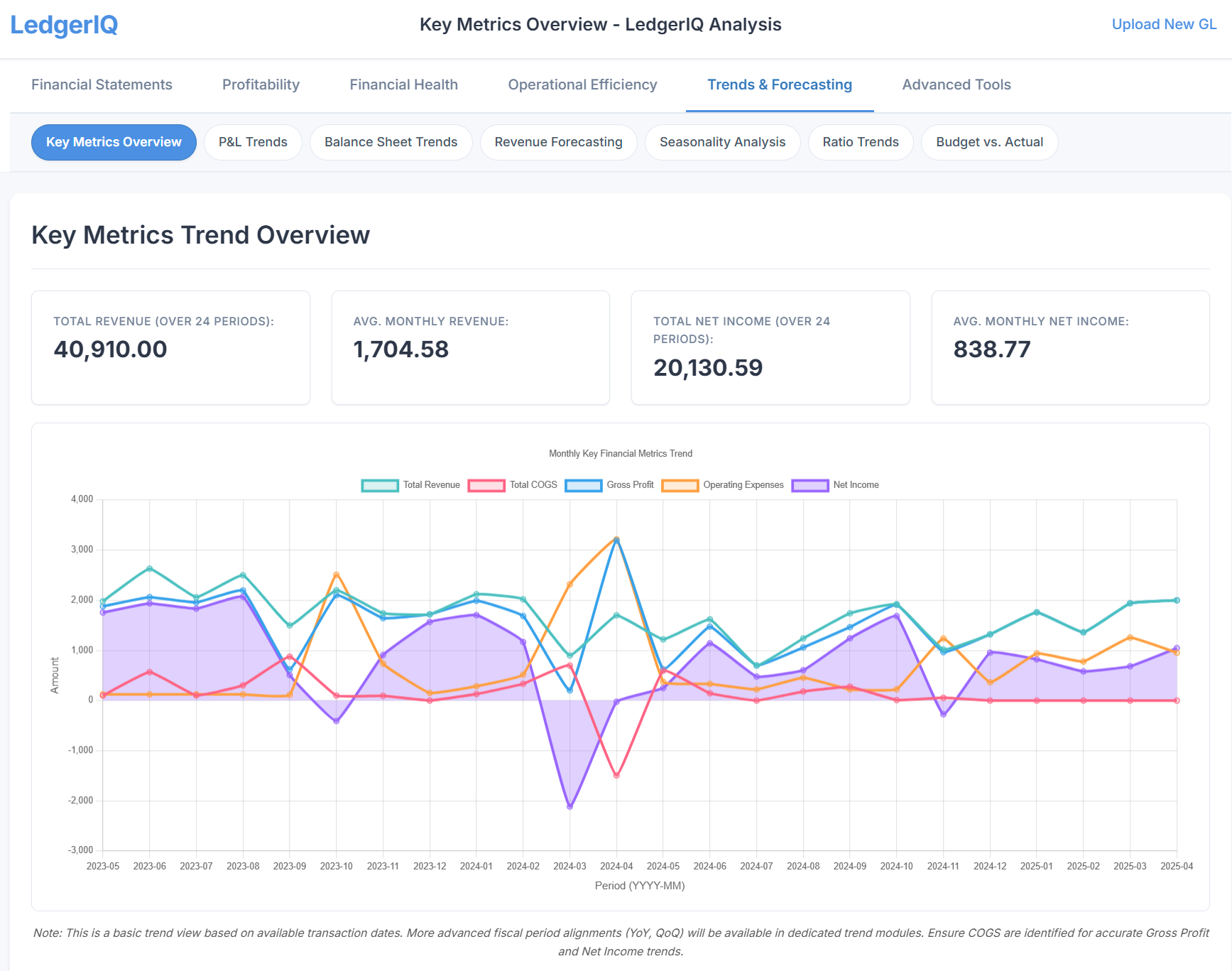
- 44 analysis modules: from financial statements (P&L, balance sheet, cash flow) through ratio analysis, DuPont decomposition, break-even modelling, credit risk scoring and working capital
- Anomaly detection: flags unusual transactions, duplicate payments and statistical outliers that summary-level tools cannot see
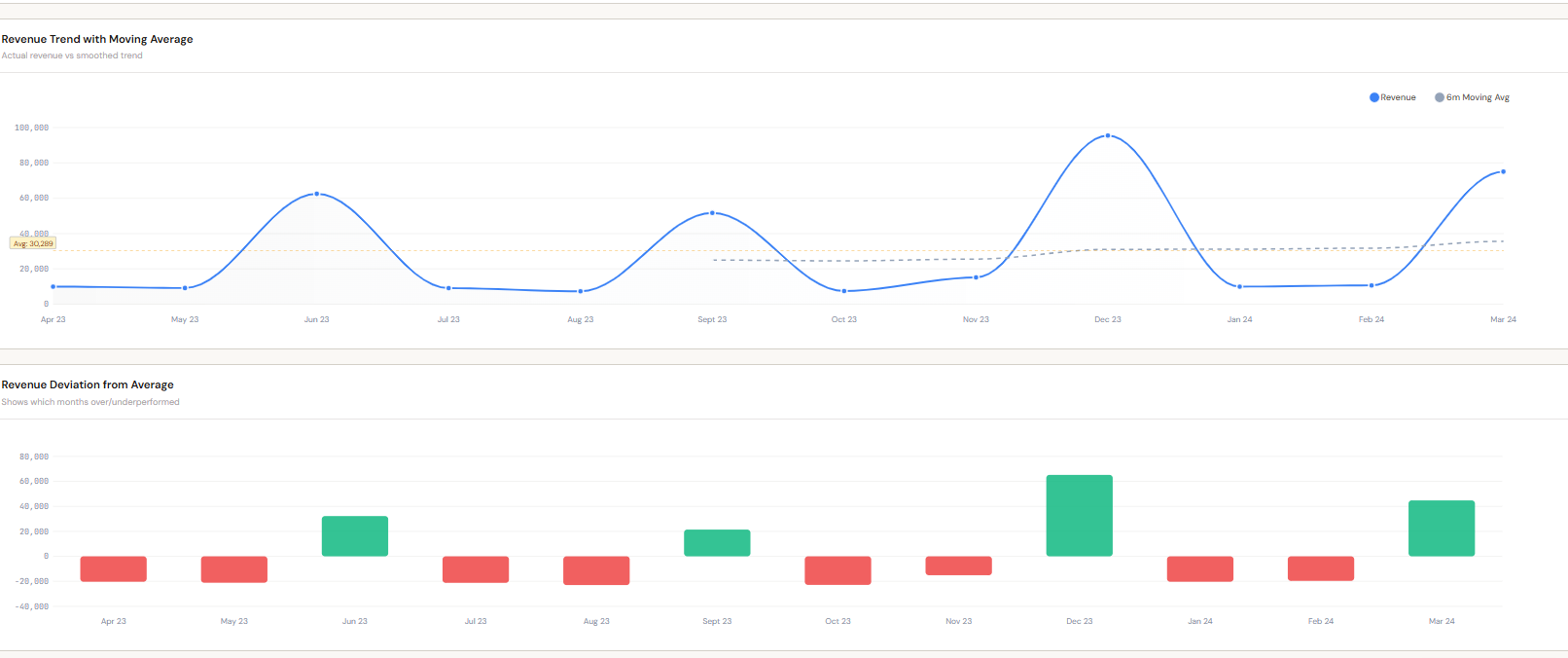
- Seasonality analysis: recurring patterns at transaction level, not just quarter-to-quarter account totals
- RiQ AI copilot: ask "Why did margins drop in October?" and get an answer that points to the transactions behind it
- Runs in your browser: the ledger is analysed in your browser rather than synced into another cloud service; what you ask RiQ is sent to RiQ to answer
- Any platform: works from the general ledger export of Xero, QuickBooks, Sage, FreeAgent, Pandle, MYOB or anything else, as CSV or Excel
- Board-quality PDF exports: reports with charts, commentary and executive summaries
Pricing
LedgerIQ is part of ReconcileIQ and is priced in credits, not per company. A full analysis is 1,000 credits, re-opening the same period in a session is free, and the GL export is always free. Every account starts with 1,000 free credits, enough for one full analysis. Starter is £5 a month for 5,000 credits; practice plans start at £78 a month (Practice Essential, 50,000 credits), which covers a full analysis for 50 clients every month.
Strengths
- Transaction-level analysis depth
- 44 analysis modules
- RiQ copilot explains results
- Works with any platform's GL export
- Credit pricing, not per company
- Anomaly detection included
Limitations
- Outside IQ Books, it works from an uploaded GL export rather than a live sync
- No multi-entity group consolidation: one entity's ledger at a time
- Newer product, smaller user base
Best for: practices that want deep, transaction-level analysis across all clients at a flat monthly cost, and advisory work where you need to explain findings to non-financial stakeholders.
2. Spotlight Reporting Strong Option
Spotlight Reporting is a New Zealand-based tool with a strong following in the Xero ecosystem. Its plans bundle Spotlight Reporting, Forecasting and Dashboard, with Spotlight Multi for consolidation as an upgrade, and it connects to Xero and QuickBooks.
Where Fathom leans towards KPI dashboards, Spotlight leans towards traditional management reporting with a modern finish. The report templates are among the best-looking you can generate automatically.
Pricing
Spotlight prices by the number of organisations. Its pricing page lists Basic at NZ$295 a month for up to 10 organisations, Super VCFO 25 at NZ$495 for up to 25, and Super VCFO 75 at NZ$995 for up to 75, excluding GST, with Enterprise on request. UK prices may differ, so check in your currency.
Strengths
- Excellent report templates
- Reporting, forecasting and dashboards bundled
- Consolidation available (Multi)
- Established, well supported
Limitations
- Priced by number of organisations
- Connects to Xero and QuickBooks only
- Works from synced account data, not transactions
Best for: Xero and QuickBooks practices that prioritise report quality and need consolidation. If your frustration with Fathom is presentation rather than price, Spotlight is worth a trial.
3. Futrli (by Sage) Forecasting
Futrli started as an independent UK forecasting and reporting tool and is now owned by Sage, trading as Futrli by Sage. It is still sold on its own, with a 14-day free trial, and it remains strongest at scenario modelling, three-way forecasting and advisory dashboards.
Pricing
Futrli prices by licence tier. Its website lists Single from $40 a month (1 to 5 licences), Starter at $250 (6 to 18), Professional at $350 (19 to 33) and Practice at $550 (34 and over). Check the current figures in your currency before you budget.
Strengths
- Strong three-way forecasting
- Scenario modelling
- UK roots
- Good advisory dashboards
Limitations
- Owned by Sage: check the roadmap if you are not a Sage practice
- Priced by licence tier
- Works from synced account data, not transactions
Note: if forecasting and scenario planning are the job, Futrli is a credible choice. If you need transaction-level review of the ledger, it is a different kind of tool.
4. Syft Analytics and Xero Analytics Xero-owned
Syft Analytics, a South African-born reporting tool, was bought by Xero in a US$70 million deal announced in 2024. Xero has since built its own analytics on it: Xero Analytics went live globally on 14 January 2026.
Syft built its following on value for money and broad platform support, with reporting, consolidation, forecasting and industry benchmarking. With Xero now the owner, check the current standalone plans and prices with Syft or Xero before you rely on them, and if your clients are all on Xero, look at what Xero Analytics already gives you.
Strengths
- Reporting, consolidation and forecasting
- Industry benchmarking
- Xero Analytics built in for Xero users
Limitations
- Standalone future under Xero ownership: check current plans
- Works from synced account data, not transactions
- Best fit for Xero-centred practices
Best for: practices whose clients are on Xero and who want analytics without adding another vendor.
5. Reach Reporting US-Focused
Reach Reporting is a US-based reporting tool built around visual dashboards and client presentations. It connects to QuickBooks Online and Desktop, Xero, MYOB, Digits, Gusto and Google Sheets.
Its dashboard builder is more flexible than fixed templates, and its plans include multi-currency consolidation, three-way budgeting and forecasting, a client portal and AI-written data storytelling.
Pricing
Reach prices by data connection. Its pricing page lists $149 a month for one connection, $290 for 10 and $550 for 25, with extra connections from $22 to $149 depending on the plan, and 30% off for annual billing. Thirty clients on monthly billing come to about $660 a month.
Strengths
- Flexible dashboard builder
- Consolidation and three-way forecasting included
- AI data storytelling
- 30-day free trial
Limitations
- Priced per data connection
- US-focused (USD pricing)
- No Sage connection listed
- Works from synced account data, not transactions
Best for: practices with US clients, or those who want flexible visual dashboards more than ledger-level depth.
Side-by-Side Comparison
| Feature | Fathom | LedgerIQ | Spotlight | Futrli | Reach |
|---|---|---|---|---|---|
| Pricing model | Company bundles | Credits per analysis | Organisation tiers | Licence tiers | Per connection |
| Entry price | $450/mo for 25 companies | £5/mo (5,000 credits) | NZ$295/mo for 10 | $40/mo (1 to 5) | $149/mo for 1 |
| About 30 clients a month | $535 | £78 (50 analyses) | NZ$995 | $350 | $660 |
| Data depth | Summary | Transaction level | Summary | Summary | Summary |
| Transaction anomaly detection | Not advertised | Yes | Not advertised | Not advertised | Not advertised |
| AI | AI commentary | RiQ copilot | Not advertised | Not advertised | AI data storytelling |
| Consolidation | Yes | No (single entity) | Yes (Multi) | Check | Yes |
| Forecasting | Three-way | Revenue forecasting | Yes | Three-way, scenarios | Three-way |
| Sage | Not listed | Via GL export | Not listed | Check | Not listed |
| Free trial | 14 days | 1,000 free credits | Check | 14 days | 30 days |
Prices excluding VAT or GST, as listed on each provider's own pricing page on 6 October 2026: Fathom, Spotlight Reporting (NZ site), Futrli, Reach Reporting. Syft and Xero Analytics are left out of the table because standalone Syft pricing could not be confirmed. "About 30 clients" assumes one Fathom company, Futrli licence or Reach connection per client, and one full LedgerIQ analysis per client a month.
Our Verdict
Fathom remains a strong product with a clean interface, consolidation and forecasting. Its company-bundle pricing is fairer than it was, but the bill still grows with every client, which sits awkwardly with how practices now want to deliver analysis: across every client, not just the premium ones.
Choose LedgerIQ if:
- You want transaction-level depth, not just summary numbers
- You want analysis across many clients at a flat monthly cost
- You want an AI copilot that explains findings to non-financial stakeholders
- You have clients on platforms other tools do not connect to, such as Sage or Pandle
Stay with Fathom if:
- You analyse a defined group of advisory clients and the bundle fits
- You need group consolidation
- You want three-way forecasting and polished management packs in one place
For UK practices that want ledger-level review across their whole client base, LedgerIQ is the strongest fit on price and depth: 44 analysis modules, transaction-level anomaly detection and an AI copilot, for a flat monthly plan rather than a per-company bill.
Try LedgerIQ Free
Upload a general ledger export from any platform. Every account starts with 1,000 free credits, enough for one full analysis across 44 modules, with anomaly detection and the RiQ copilot.
Explore LedgerIQFrequently Asked Questions
It can be. Fathom Pro is $450 a month including 25 companies, then $17 for each extra company, so it suits a practice that wants polished management packs, three-way forecasts and group consolidation for a core set of clients. If you want analysis across every client, a credit-based tool scales more cheaply: one full LedgerIQ analysis is 1,000 credits, and the £78 Practice Essential plan carries 50,000 credits a month.
Not the same, but you can try before paying. Every ReconcileIQ account starts with 1,000 free credits, enough for one full LedgerIQ analysis of a general ledger. Fathom and Futrli offer 14-day free trials and Reach Reporting a 30-day trial.
Data depth and structure. Fathom syncs summarised account data from your accounting software and is strong on consolidation, forecasting and presentation. LedgerIQ reads the full general ledger, transaction by transaction, so it can detect anomalies and duplicates and answer questions about specific transactions, but it analyses one entity at a time rather than consolidating a group.
FreeAgent, yes. Fathom's pricing page lists Xero, QuickBooks Online and Desktop, MYOB, FreeAgent, Excel and Google Sheets. Sage is not listed. LedgerIQ works from any platform's general ledger export, including Sage, and on IQ Books it runs on the live ledger.
It depends on the job. For transaction-level analysis across many clients at a flat monthly cost, LedgerIQ. For polished reporting and forecasting on Xero or QuickBooks, Spotlight Reporting. For scenario forecasting, Futrli. If your clients are all on Xero, look at Xero Analytics first. Reach Reporting suits practices with US clients.