Year-end accounts software that prepares the working papers.
Hand over a client's records. RiQ prepares the year-end file behind the statutory accounts: the extended trial balance, fixed assets, capital allowances, finance reconciliations, VAT and the tax computation, every posted figure cell-linked and tied out. You review it, ask for changes, and sign it off.
EFinance reconciliationsOne sheet per HP, loan or completion statementRec
FVATTBC
GCorporation tax computationRec
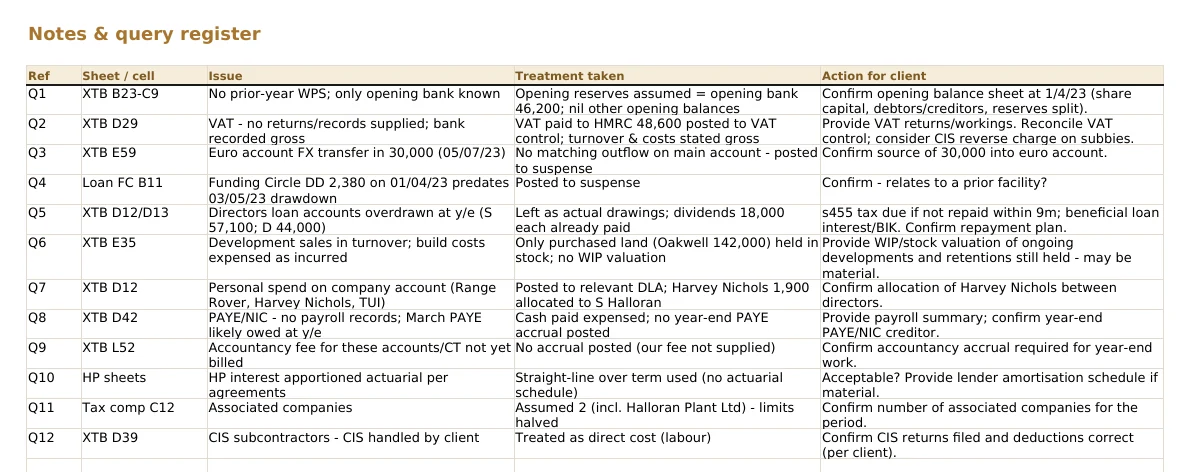
HNotes and query register12 queries, 4 for the clientFor review
Illustrative fileAwaiting your sign-off
01 · The client's records
Whatever the client sends, in it goes.
There is no special export to produce. Start a job, choose the entity, and give PrepIQ the client's records as they arrive: a ledger from any platform, the paperwork behind it, and last year's file if there is one.
The ledgerA general ledger or bookkeeping export from Xero, QuickBooks, Sage, Pandle or any other system, in Excel, CSV or PDF.
The paperworkBank statements, hire purchase and loan agreements, mortgage interest certificates, completion statements, and scanned or photographed receipts and invoices.
Last year's papersThe prior-year working papers, so the file rolls forward rather than starting blank.
Your templateYour firm's own working papers template, if you have one. Otherwise the bundled template for the entity is used.
A noteAnything RiQ should know about this client, in your own words. Client statements in it are checked against the records, not taken on trust.
The year end accounts checklist PrepIQ asks for when you start a job:
Bookkeeping: a full-year transactions or GL export and the trial balance, in CSV or Excel
Bank statements for the whole year, including any second accounts such as Wise, PayPal or Stripe
Aged debtors and aged creditors listings
Finance agreements: hire purchase, loans, mortgages and any completion statements
Payroll: P11s, P32 or P60s if there are employees (in Ireland, the Employment Detail Summary and payroll submissions)
VAT returns for the year if the client is VAT registered (VAT3s in Ireland)
Last year's working papers as an Excel file, and your firm template if you use one
A quick note on anything unusual
02 · Your firm profile
Set your conventions once, every job follows them.
The firm profile is how PrepIQ works the way your practice does. It picks the jurisdiction and the reporting framework, decides how tax is handled, and carries your standing instructions into every job.
Prepare it and post the tax journalPrepare it, but post no tax journalLeave tax to us entirely
Client email
Write one when there are client questionsNever, this is in-house work
Dividends
Standard treatmentOnly when we name one
Rounding
To the penny or centWhole units
Query threshold
Raise a query for any unexplained difference over a figure you set
Anything else
“Flag any debtor over 90 days. Depreciate fixtures at 15% reducing balance.”
The framework setting is what makes PrepIQ micro-entity accounts software as much as small-company software: choose FRS 105 and the papers are prepared on that basis.
03 · The working papers set
The file a reviewer expects, populated and tied out.
These are the types of working papers a year-end file needs, filled in your template's own conventions. Every posted figure is linked to its working sheet, and any figure typed in is labelled with its source. The trial balance has to balance before the job can finish.
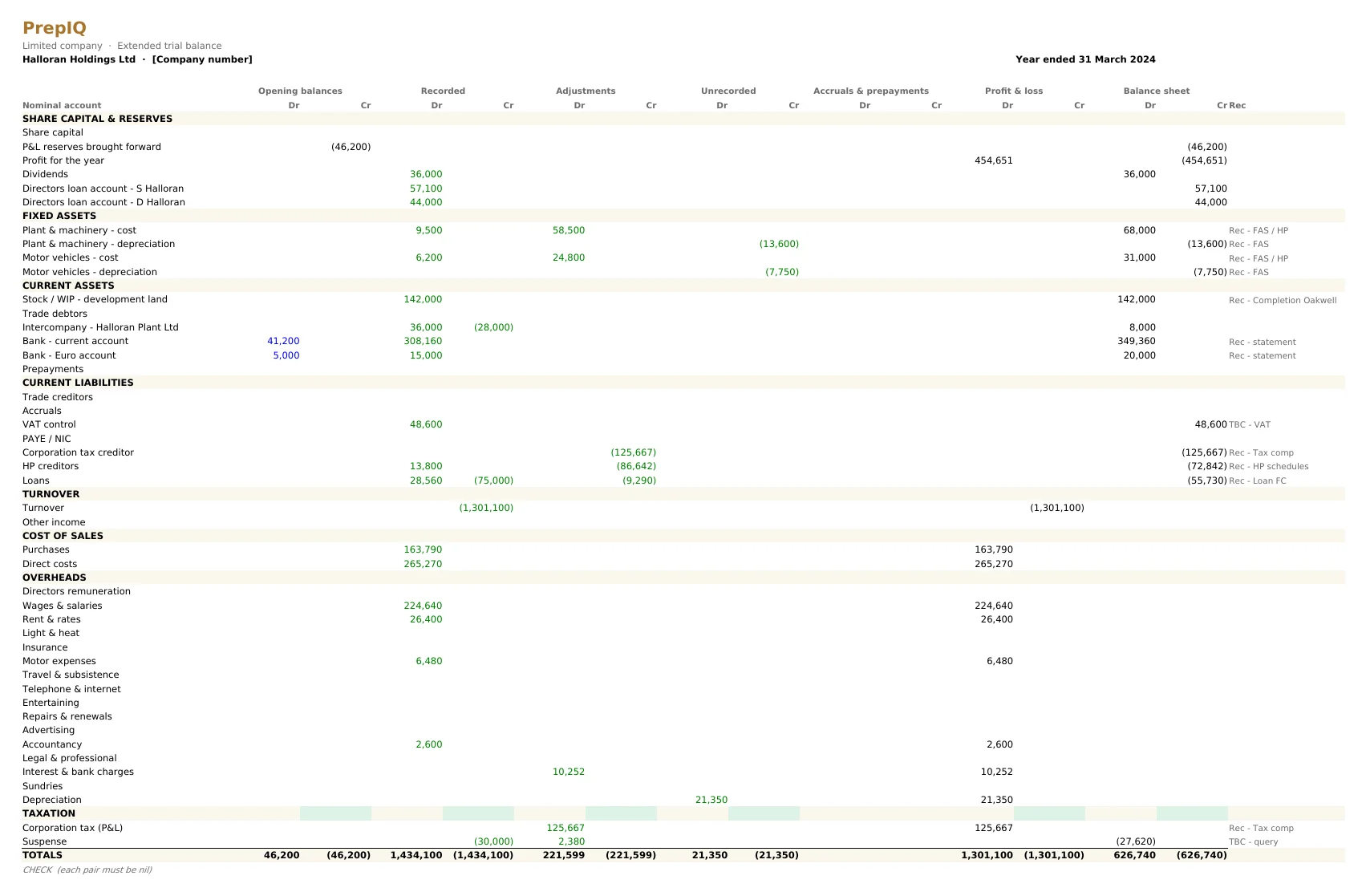
A demo company's extended trial balance. Green figures are linked from working sheets; Rec marks reference the schedule that supports each line; TBC marks a query.
Extended trial balanceOpening balances, recorded, adjustments, unrecorded, accruals and prepayments, profit and loss and balance sheet columns, each pair footing to nil, with the year-end adjustments derived from what was posted.
Records summaryThe client's bookkeeping mapped to the nominals the trial balance expects, reclassifications flagged rather than buried.
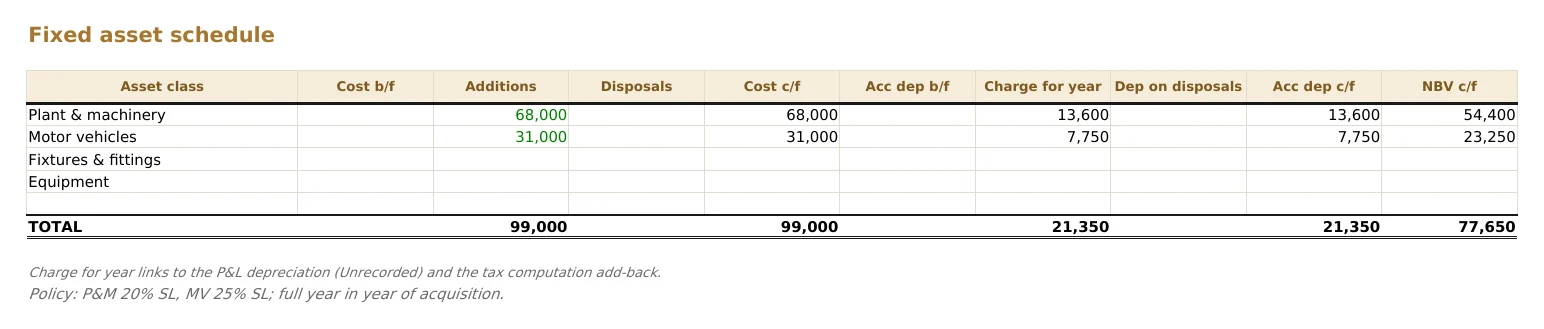
Fixed assets and depreciationThe register built or rolled forward: additions, disposals, gains and losses, and the year's charge by class.
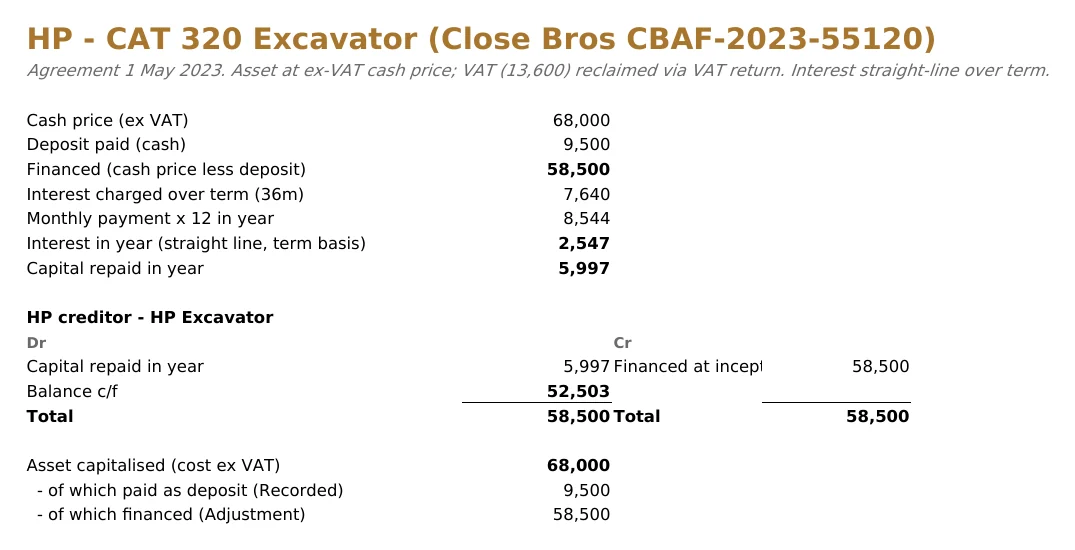
Finance reconciliationsOne cell-linked sheet for each hire purchase, loan, mortgage or completion statement, with capital and interest split out. One sheet per agreement, never merged.
Debtors, creditors, accruals and prepaymentsThe year-end balances and the adjustments behind them, including a brought-forward accrual or prepayment released, or left standing and flagged.
Bank, VAT and payrollEach control account reconciled to its source, with the VAT scheme named.
Director's loan account and dividendsSeparate accounts per director, an overdrawn balance flagged; drawings and capital for a sole trader.
Notes, queries and journalsA query register, a journals sheet with every adjustment, and a written log of every posting and judgement.
Checked before deliveryThe set is recalculated and checked before it reaches you: every Dr and Cr pair nil, no formula errors. Nothing is plugged to force a balance; a genuine gap goes to a flagged query.
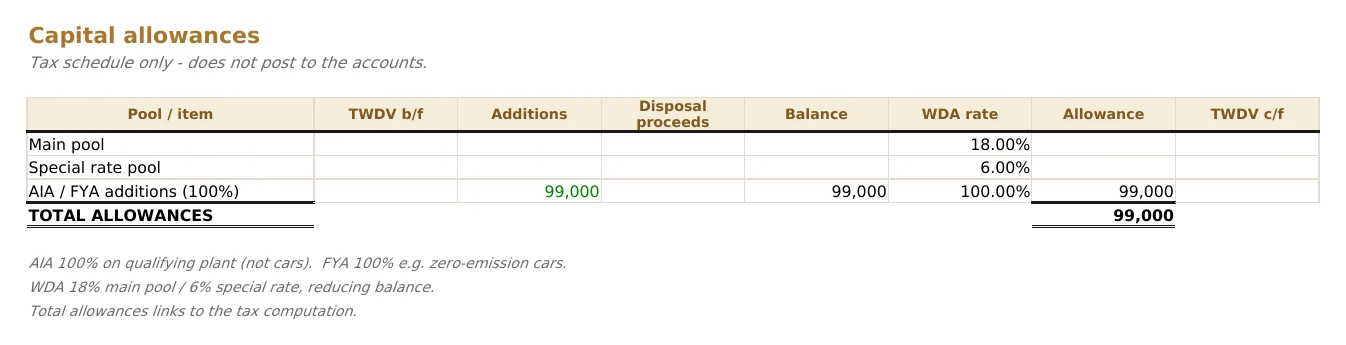
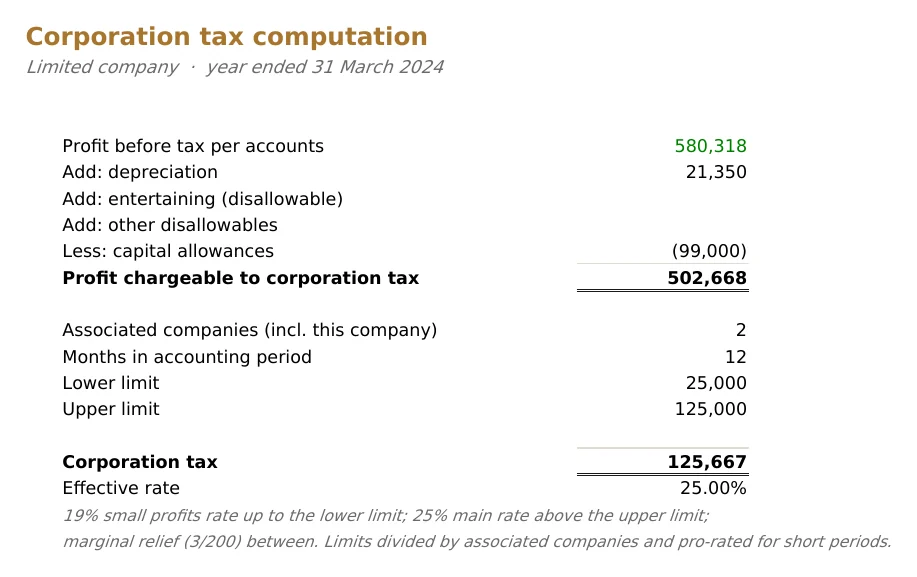
The tax computation and the capital allowances schedule follow the jurisdiction in your firm profile: HMRC rules for the UK, including Northern Ireland, or Revenue rules for Ireland. Capital allowances are a tax schedule only and feed the computation, never the accounts.
Demo company, year ended 31 March 2024, when the main pool rate was 18%. For periods from 1 April 2026 (6 April for income tax) the rate is 14%, and a period that straddles the change uses a time-apportioned rate with the working shown on the cell.
Corporation tax at 19% up to the lower limit and 25% above the upper limit, with marginal relief between, the limits shared across associated companies and pro-rated for short periods, and apportioned across financial years.
Capital allowances: AIA on qualifying plant and machinery by default, first-year allowances where they apply, cars to the main or special rate pool by emissions, writing-down allowances at the rate for the period, and balancing allowances and charges on disposal.
An overdrawn director's loan still outstanding nine months after the year end: the section 455 charge worked and flagged.
Sole traders: trade, property and savings income kept apart for the self-assessment return; the private-use restriction applied to capital allowances; motor costs claimed by HMRC mileage or actual running costs, never both.
IrelandRevenue · CRO · euro
Corporation tax at 12.5% on trading income and 25% on non-trading income, with the close company surcharge worked and shown.
Wear and tear over eight years, with cars capped.
An overdrawn director's loan: section 438 worked and flagged.
Prepared to Revenue and CRO conventions throughout, in euro, with VAT3 periods and the CT1 due nine months after the period end. The Irish rulebook in full.
05 · Review and sign-off
You stay the accountant. Every call is flagged.
Where a treatment needs your judgement or the client's confirmation, PrepIQ raises a query rather than deciding silently. Nothing is released until you sign it off.
RiQ's notesEvery posting, assumption and judgement in a written log beside the workbook, so the review starts from a clear trail.
Ask RiQAsk for a change in plain words, or add documents the client forgot, and RiQ revises the same set with the context of what it already did.
Sign offWhen it is right, sign it off and download the working papers.
Client emailA draft email to the client listing the documents and confirmations still needed, in plain English, written as from your firm. Off if the work is in-house.
Client emailDraft
Draft: review before sending
Hi Sarah, we are finishing the accounts for the year to 31 March. A few things would help us close them.
Documents we need
The lender's schedule for the van finance.
A payroll summary for March.
A few things to confirm
The 30,000 paid into the euro account in July: where did it come from?
[Your name], [Firm]
06 · Last year, and your template
Continuing clients continue. Your file stays yours.
Give PrepIQ last year's working papers and it carries on from them. Give it your firm's template and it fills it through the template's own formulas, the way a junior would, rather than rebuilding it.
Opening balances carriedLast year's closing balance sheet becomes this year's opening balances, proven to tie exactly. Profit and loss starts at nil.
Schedules continueFixed asset, capital allowance and finance schedules pick up their brought-forward figures, so depreciation and pools continue where they left off.
Your template, untouchedOn a firm template PrepIQ only writes values into the cells meant for input. It never inserts rows, renames sheets or rewrites formulas, so your cross-references keep working. A firm template of any layout is mapped sheet by sheet first.
From IQ BooksFor UK clients on IQ Books, a year-end job can be started from the organisation itself, and the adjusting journals come back into the ledger through Year-end close, previewed before anything posts.
Prior file winsWhere both a prior-year file and a blank template are supplied, last year's file is the base, because that is where the client's history and your references live.
07 · Statutory accounts
Where it sits in statutory accounts preparation.
Most of the hours in year end accounts preparation go before the statutory accounts exist: turning the records into a balanced trial balance and a reviewable file. That is PrepIQ's part. Your accounts production software takes the signed-off trial balance on to the accounts and the filing.
1 · The clientRecords
Ledger, statements, agreements and receipts, in whatever form they come.
2 · PrepIQWorking papers
Extended trial balance, lead schedules, journals and the tax computation, posted figures cell-linked.
3 · YouReview and sign-off
Queries answered, changes asked for, the file approved.
4 · Your softwareStatutory accounts
FRS 102 Section 1A or FRS 105 accounts and the filing, in IRIS, TaxCalc, CCH, BTCSoftware, Capium, Sage or similar.
PrepIQ is not statutory accounts software on its own: it works alongside the accounts production software you already use. It does not file accounts at Companies House or the CRO, or a CT600.
08 · Credits and privacy
On your practice plan, scoped to you.
PrepIQ is included on the ReconcileIQ practice plans, Practice Essential and above, and each job draws from the plan's credit allocation.
5,000credits a year-end job on RiQ default
10,000credits on RiQ maximum, for complex or messy records
1,250credits an Ask RiQ revision (2,500 at maximum)
2jurisdictions: the UK and Ireland
Scoped to youEach job belongs to the user who created it and nobody else sees it.
Review before releaseA finished set waits for your sign-off. It is never finalised for you.
Removed when finishedWhen you finish a job, its client files are deleted from our servers.
Questions
Year-end software, answered.
What practices ask before they hand PrepIQ a client file. The PrepIQ overview covers what working papers are and how PrepIQ compares.
What does PrepIQ produce?
A complete year-end working papers set in your firm's template: a records summary, the extended trial balance, the fixed asset register and depreciation, capital allowances, a reconciliation sheet for each hire purchase, loan, mortgage or completion statement, VAT, the director's loan account or drawings, the tax computation, a notes and query register and a journals sheet. Alongside the workbook come a written adjustments log and, if you want one, a draft email to the client listing what is still needed. Every posted figure is a live cell link back to its working sheet.
Is PrepIQ statutory accounts software?
Not on its own. PrepIQ prepares the working papers that statutory accounts are built from: the balanced extended trial balance, the lead schedules, the year-end journals and the tax computation. Your accounts production software, such as IRIS, TaxCalc, CCH, BTCSoftware, Capium or Sage, then takes the signed-off trial balance through statutory accounts preparation and filing. PrepIQ does not file accounts at Companies House or the CRO, or a CT600 at HMRC.
Does it prepare micro-entity accounts under FRS 105?
It prepares the working papers for them. Set the reporting framework in your firm profile to FRS 105 (micro-entity), FRS 102 Section 1A or full FRS 102, and the papers are prepared on that basis. The micro-entity accounts themselves are then produced and filed in your accounts production software.
What types of working papers does it prepare?
The ones a reviewer expects in a year-end file: the extended trial balance, a records summary from the client's bookkeeping, the fixed asset register, capital allowances, finance reconciliations for each agreement, debtors, creditors, accruals and prepayments, bank, VAT, payroll, dividends and the director's loan account (drawings and capital for a sole trader), the tax computation, and a notes and query register.
Does it handle sole traders and limited companies?
Yes. You choose the entity for each job and PrepIQ uses the matching template. Limited company sets handle directors' loan accounts, dividends, reserves and the corporation tax charge. Sole trader sets keep trade, property and savings income apart for the self-assessment return and roll drawings and profit into capital; the personal tax itself is left to your tax software.
Does PrepIQ handle Irish year ends?
Yes. Your practice sets its jurisdiction once, United Kingdom or Ireland, and every job follows it: the tax rules, the capital allowances, the director's loan charge, the labels and the currency. A mixed practice can override it for a single client. Northern Ireland practices choose United Kingdom, because a Northern Ireland company pays UK corporation tax to HMRC.
Can we use our own working papers template?
Yes. Upload your firm's working papers template as an Excel file and it takes precedence over the bundled one. PrepIQ fills it through its own formulas and input cells, and never inserts rows, moves sheets or rewrites your formulas, so your cross-references keep working.
Can it prepare working papers from a Xero ledger?
Yes. A general ledger or bookkeeping export from Xero, QuickBooks, Sage, Pandle or any other system works, in Excel, CSV or PDF, and so do scanned or photographed records. Add the supporting paperwork, such as bank statements and finance agreements, and PrepIQ prepares the set from all of it.
What if we compute and file the tax ourselves?
Set the tax computation in your firm profile. Prepare it and post the tax journal; prepare it but post no tax journal, so you can check it against your own; or leave tax to you entirely. Whichever you choose, the rest of the set still ties out.
Can it carry forward last year's working papers?
Yes. Upload last year's finished working papers and PrepIQ rolls them forward: last year's closing balance sheet becomes this year's opening balances, proven to tie, and the fixed asset, capital allowance and finance schedules continue from their brought-forward figures. Without a prior file, the client opens at nil.
How much does PrepIQ cost?
PrepIQ is included on the ReconcileIQ practice plans, Practice Essential and above. Each year-end job draws 5,000 credits from the plan's allocation on the RiQ default preparation depth, or 10,000 on RiQ maximum. Each later Ask RiQ revision is 1,250 credits, or 2,500 at maximum.
Do I still review the work?
Always. Every judgement and client query is flagged in the notes and query register, nothing is released until you sign it off, and you can ask RiQ for changes or add documents and it revises the same set.
What happens to the client's records afterwards?
Each job is scoped to the user who created it. When you finish a job, its client files are deleted from our servers; only the job's summary record is kept.
Around the year end, the rest of the work.
PrepIQ is one of five ReconcileIQ products. These are the ones that keep a client's books and make the most of them.